
Updated July 2026
So, you have gone through the checklist. You understand your goals. You know your time horizon. You have accepted that markets will go up…and down. You are ready. Now comes the harder part. Not intellectually, but behaviourally:
What do you actually do next?
Because this is where many investors get stuck. They spend weeks (or months) researching, comparing, optimizing…and never take the first step. This article is about removing that friction.
Not by giving you the perfect plan but by giving you a simple, robust starting point you can actually execute.
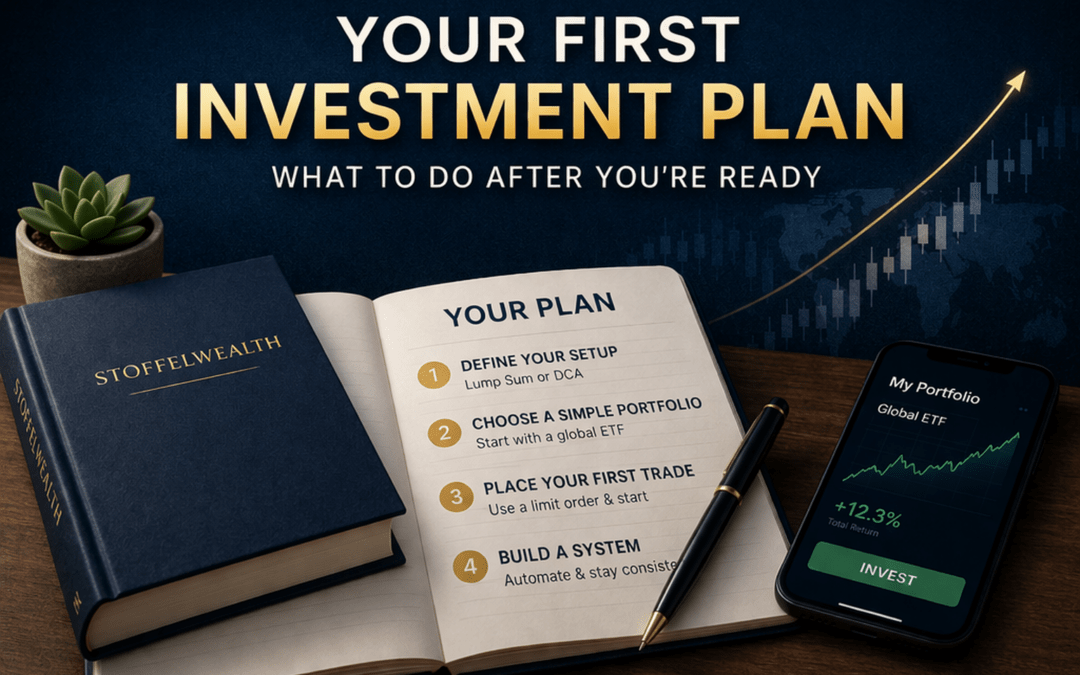
Step 1: Define Your Investment Setup
Before choosing any ETF or placing any trade, you need clarity on how you will invest.
There are two main ways to deploy your capital: investing everything as a lump sum or spreading it out gradually over time through Dollar-Cost Averaging (DCA). There is no universally correct answer. Lump sum is mathematically optimal on average, but if a big drop right after investing would make you panic, DCA is likely the better choice for you. DCA is often easier psychologically, since it spreads both the risk and the decision over time.
If you are unsure, a simple approach is to split your capital into 3 – 6 parts and invest over time. What matters more than the method is this: You stick to it.
Just as important as the method is the rhythm. Decide upfront on a monthly contribution amount and a fixed investment day, such as the first Monday of the month or your salary day. This turns investing from a decision into a habit.
Step 2: Choose a Simple Portfolio
This is where many beginners overcomplicate things. You do not need 10 ETFs. You do not need to optimize every percentage. You need something that works.
The simplest starting point: a perfectly valid portfolio for many investors is one global equity ETF. This gives you thousands of companies, global diversification, and automatic exposure to growth, all in a single trade.
There are many options depending on your region and jurisdiction. Some examples are:
- iShares MSCI ACWI UCITS ETF (SSAC) tracking the performance of the MSCI All Country World Index
- Vanguard Total World Stock ETF (VT) tracking the performance of the FTSE Global All Cap Index
An alternative to the one ETF option is to combine 2 ETFs covering developed and emerging markets separately. This might be suitable if you want to be able to control the weight of Emerging Markets in your portfolio. Examples are:
- iShares Core MSCI World UCITS ETF (SWDA) tracking the performance of the MSCI World Index.
- iShares Core MSCI EM IMI UCITS ETF (EIMI) tracking the performance of the MSCI Emerging Markets Investable Market Index.
If you feel overwhelmed by the choices, pick one broad global ETF and start. You can refine later; getting started matters more than optimizing.
These are examples only – not personal recommendations. Ensure any ETF you choose is appropriate for your jurisdiction and tax situation.
Slightly more advanced (optional): if you want to go one step further, consider allocating 80 – 90% to a global equity ETF and 10 – 20% to bonds, depending on your risk tolerance. But be careful: complexity is not the goal. Consistency is.
Step 3: Place Your First Trade
This is where theory meets reality, and where hesitation often kicks in. As discussed in your readiness checklist, use limit orders and avoid market orders, especially as a beginner. Set a reasonable price you are comfortable with and execute. For most long-term investors, setting the limit near the current price is sufficient; the exact cent does not matter.
Your first trade will not be perfect. The price might go down after you buy, or up right after you hesitate. This is normal. The goal is not to “get it right.” The goal is to get started.
Step 4: Build a System (Your Real Edge)
Your portfolio matters. But your behavior matters more, and it’s the only edge you truly control. Automate what you can: set a fixed investment schedule, reduce the number of decisions, and remove emotion from the process.
You will see market headlines, predictions, and “urgent” news. Most of it is irrelevant to long-term investing. Your job is simple: stay invested, stay consistent. Instead of checking daily, review your portfolio quarterly or semi-annually. Rebalance if needed, and stay aligned with your plan.
Step 5: What Not to Do
Sometimes, avoiding mistakes is more important than making perfect decisions.
Don’t try to time the market. You will not consistently buy at the bottom and sell at the top; no one does, not professional fund managers, not financial media pundits, and not you. The cost of waiting for the “right moment” to invest is almost always higher than the cost of buying at a slightly wrong price, because time in the market matters more than timing the market. Every month spent waiting for clarity is a month of lost compounding, and clarity rarely arrives before the move has already happened.
Don’t chase trends. Be careful with things that are suddenly popular and have already gone up a lot; they are often driven by hype rather than fundamentals, and by the time a theme is trending in the news or on social media, the easy gains have usually already been made. The discipline required here is to be boring on purpose: sticking with a diversified, unglamorous portfolio while everyone else chases the latest story is uncomfortable, but it is precisely what protects you from buying at the top.
Don’t overcomplicate. More ETFs do not mean better results, and more activity does not mean more returns. A simple portfolio that you maintain consistently will outperform a complex one that you constantly tinker with, because complexity creates friction, and friction creates inaction. Every extra fund, every extra decision point, is another opportunity to hesitate, second-guess yourself, or abandon the plan altogether.
Your First Year as an Investor
This part is rarely discussed but it is critical. At some point, your portfolio will be down, maybe 5%, maybe 10%, or more. This is not a failure. This is investing, and in fact, it is a necessary part of the process.
Your first year is not about returns. It is about answering one question: Can you stay invested when it feels uncomfortable? Because that is where long-term wealth is built.
From Readiness to Action
You do not need a perfect plan. But you need a simple structure, a clear process, and the willingness to start.
If you have completed the readiness checklist, you already have the foundation. Now it is time to take the next step.
Final Thoughts
- Investing is not about making one great decision; it is about making many small, consistent decisions over time
- Start simple and let a single global equity ETF do most of the work at first
- Stay consistent, and let compounding do its work over years, not weeks
- Avoid timing the market, chasing trends, and overcomplicating your portfolio
- Expect volatility in your first year; it is normal, not a sign of failure
- Don’t wait for perfect conditions, because they don’t exist
Your portfolio will be shaped by markets, interest rates, and economic cycles, none of which you control. Your behavior is the one variable entirely within your hands. So the real question is not whether now is a good time to invest. It is whether you have built the habits to stay the course when it is not.