
What a Simple Map Reveals About the Future of the Global Economy
Introduction
Sometimes a single image can change the way you see the world.
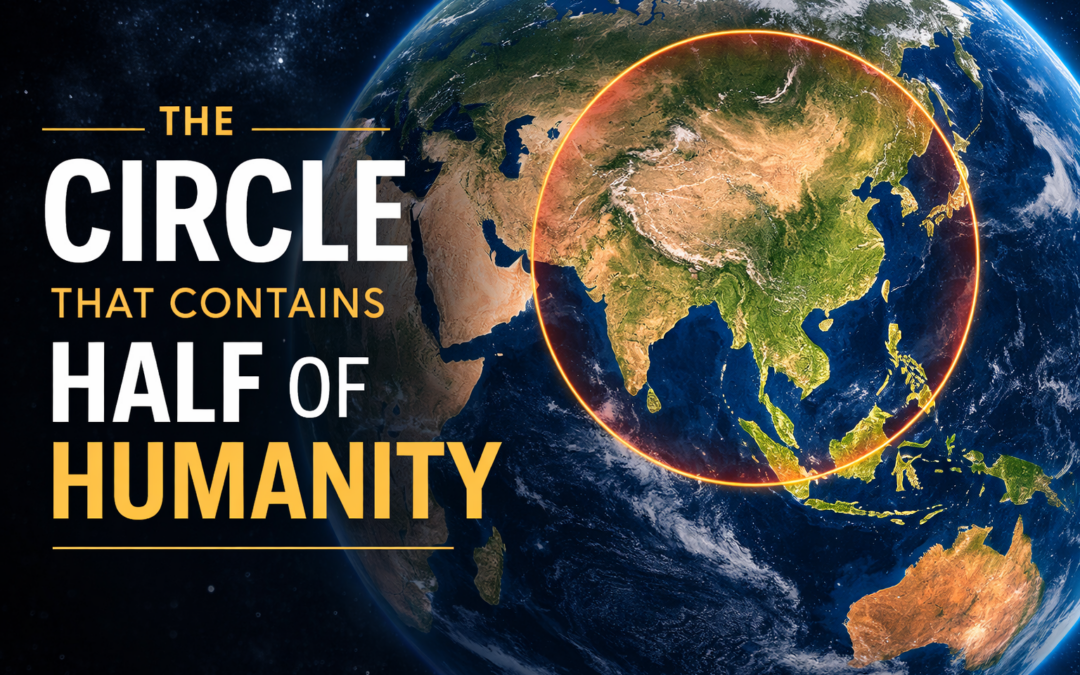
A few years ago, a striking visualization began circulating online: a circle drawn across Asia containing more people than the rest of the planet combined. Inside that circle live roughly four billion people, or more than half of humanity. Depending on the version used, the circle covers only a small share of Earth’s total surface and roughly a tenth of its land area, yet still contains the majority of the world’s population.
At first glance, it feels almost impossible. The circle does not even look that large compared with the rest of the world map.
Yet within it lie some of the most densely populated regions on Earth: China’s eastern provinces, India’s vast population centers, Indonesia’s islands, Bangladesh, Vietnam, the Philippines, and much of Southeast Asia. In many commonly cited versions of the map, Japan is also included, while more precise later calculations manage to exclude most of it and still capture half of humanity.
The visualization, often referred to as the Valeriepieris Circle, is not just a geographical curiosity. It was originally popularized in 2013 by teacher Ken Myers, whose online handle “valeriepieris” gave the map its name, and was later refined by economist Danny Quah, who identified a more mathematically precise circle containing half of humanity.
It highlights something much deeper: a massive concentration of humanity, and therefore economic potential, within a relatively small region of the planet.
For long-term investors trying to understand where the world economy is headed, this map offers an important perspective.
Population Is Not Evenly Distributed
Looking at a world map, it’s easy to assume that people are spread relatively evenly across continents. In reality, the opposite is true.
Large parts of the world are sparsely populated:
- Canada
- Siberia
- Australia
- Large desert regions in Africa and the Middle East
- Vast areas of South America
Meanwhile, parts of Asia are extraordinarily dense. A few examples illustrate the scale (rounded to avoid going stale as data updates):
- China: over 1.4 billion people
- India: over 1.4 billion people
- Indonesia: around 275–280 million people
- Pakistan: over 240 million people
- Bangladesh: around 170 million people
Many of these populations live in areas smaller than many Western countries. When combined, these regions form the enormous population cluster captured inside the Valeriepieris Circle.
This concentration of people has profound economic implications. Where people gather, economic activity tends to follow.
Economic Gravity Follows Population
Population alone does not automatically translate into economic prosperity. Productivity, institutions, capital formation, and political stability matter enormously. But over long periods, dense population centers often create powerful economic ecosystems.
Inside this circle we find:
- Several of the largest economies in the world
- The global manufacturing hub
- Rapidly growing middle classes
- Expanding urban centers
- Increasing financial market development
China, Japan, and India alone account for a significant share of global GDP. Beyond them, countries like Indonesia, Vietnam, Thailand, and the Philippines are experiencing steady economic growth and rising consumption.
Over time, these demographic forces tend to reinforce themselves.
More people lead to:
- Larger domestic markets
- Greater labor supply
- Faster urbanization
- Deeper capital markets
These dynamics gradually shift the center of gravity of the global economy toward this region.
At the same time, it is important to note that the countries inside the circle are not homogeneous. Parts of East Asia, such as China and Korea, are aging rapidly, while South Asia and parts of Southeast Asia remain much younger and continue to grow in population; an important nuance for investors evaluating long-term opportunities.
Manufacturing Powerhouses
Another reason this region matters for investors is its role in global production. Many of the world’s most important manufacturing centers lie within or close to this population cluster:
- China
- South Korea
- Japan
- Taiwan
- Vietnam
- Thailand
These countries are deeply integrated into global supply chains. From electronics and semiconductors to automobiles and consumer goods, much of what the world consumes is produced somewhere inside this geographic area.
Even as supply chains evolve and diversify, the industrial infrastructure built across Asia over decades remains extraordinarily difficult to replicate elsewhere.
For investors, this means that a large share of global economic activity and corporate earnings exposure continues to be linked to the region, whether directly through Asian assets or indirectly through global companies that depend on Asian supply chains and demand.
The Rise of the Asian Consumer
While Asia has long been associated with manufacturing and exports, another trend is steadily reshaping the global economy: the rise of the Asian middle class.
Hundreds of millions of people are gradually moving into higher income brackets. Projections suggest that Asia will account for a majority of the global middle class in the coming decades.
This transition changes spending patterns dramatically.
As incomes rise, demand increases for:
- Housing
- Transportation
- Healthcare
- Education
- Technology
- Financial services
- Travel and leisure
The result is a powerful shift from export-driven growth toward domestic consumption.
For long-term investors, this is one of the most important structural trends of the coming decades, influencing sectors ranging from consumer goods and e‑commerce to financial services and infrastructure.
Urbanization and Infrastructure
Urbanization is another major force within the circle. Across Asia, millions of people continue to move from rural areas into cities every year.
Urbanization typically drives large investments in:
- Infrastructure
- Transportation networks
- Utilities
- Housing
- Communication systems
These developments not only improve living standards but also increase productivity and economic efficiency.
Over time, they contribute to deeper financial markets, larger pools of savings, and greater investment opportunities across both public and private markets.
Why This Matters for Long-Term Investors
The Valeriepieris Circle is not an investment strategy. It does not tell you which stock to buy or which market will outperform next year.
But it does highlight something important: where much of the world’s future economic activity is likely to occur.
Long-term investors often benefit from understanding broad structural trends such as:
- Demographic shifts
- Economic development
- Urbanization
- Rising consumption
These forces tend to unfold over decades rather than months or quarters.
They influence global trade, corporate earnings, and the direction of economic growth.
It is also worth keeping in mind that while the circle captures where people live, much of the world’s existing capital stock and wealth is still outside it today. While the population is inside the circle, the global reserve currency (USD) and the deepest equity markets (US) remain outside. The story of the next few decades is partly about how far economic output and wealth converge toward this population center and where they do not.
Understanding where these forces are strongest can help investors maintain a broader perspective on how the world economy is evolving, while still recognizing the political, regulatory, and geopolitical risks that differ widely across countries inside the circle.
A Perspective From Singapore
For readers in Singapore (where I live), the map carries an additional layer of meaning. Singapore sits near the center of this population cluster.
Within a few hours’ flight from Singapore lie major cities in:
- China
- India
- Indonesia
- Vietnam
- Thailand
- Malaysia
- The Philippines
This geographic positioning helps explain why Singapore has developed into a major financial and trade hub connecting global capital with Asian growth. Capital, talent, and companies based in Singapore are often oriented toward serving the consumers, factories, and infrastructure projects located within this circle.
Final Thoughts
The Valeriepieris Circle reminds us that the world’s population, and increasingly its economic momentum, is highly concentrated. A simple circle drawn on a map captures a powerful reality: more than half of humanity lives inside it.
For investors trying to understand the long-term evolution of the global economy, this perspective matters. Over time, economic power tends to follow people, even if it does not do so in a straight line. And a remarkable number of people live within that circle.