

Last week, I explored risk premia and how they can help you build long-term wealth. If you have made it through that post, well done! Now, let’s make it practical. How do you actually get started?
In this post I will explain the steps to take to actually get started with risk premia harvesting…whether you are in your early twenties or at a later stage in life. The earlier you start the better to make full use of the magic of compounding.
Getting started is straightforward and does not require a lot of effort on your part. In short, these are the steps you need to take:
- Understand the fundamentals of risk premia
- Understand the magic of compounding
- Determine your monthly investment budget
- Identify suitable asset(s) to invest in
- Select a stockbroker and open an account
- Place your first buy order
- Schedule monthly recurring investments
- Review and rebalance your portfolio annually
Understand the Fundamentals of Risk Premia
There is no way around understanding the fundamentals of risk premia. Only by understanding what they are and why it makes sense to invest in them, can you make an informed decision. After all, it is your decision. Do not just believe anything I or others tell you. Always do your own homework first and if you are comfortable (and only then), you can take the next steps.
Remember, risk premia are the long-term rewards you receive for taking on specific types of market risk, like equities, credit, or value exposure.
Understand the Magic of Compounding
One of the key ingredients for the risk premia harvesting is time. The longer your investment horizon, the more you can benefit from the compounding effect. Let’s visualize this effect using the following scenario:
- Initial investment: USD 10,000
- Annual return: 7%
- Investment starts at ages 25, 35, and 45
- Investment ends at age 60 for all three cases
Only by looking at the following graph you can see how important time is for compounding to work:
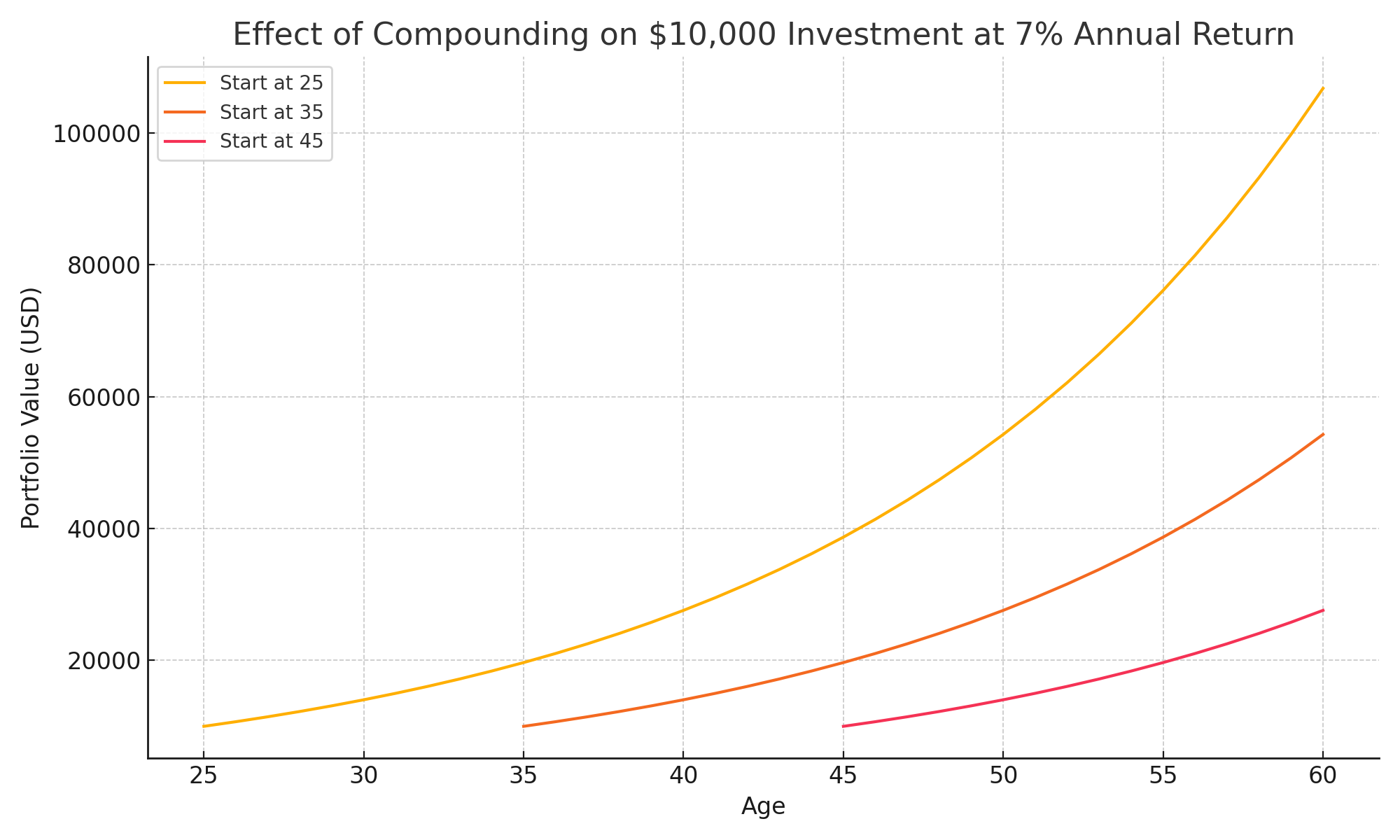
Let’s look at the actual total returns of those 3 scenarios:
| Starting age | Investment horizon | Amount at age 60 | Total Return (%) |
| 25 years | 35 years | 106,766 | 968% |
| 35 years | 25 years | 54,274 | 443% |
| 45 years | 15 years | 27,590 | 176% |
Just compare the total return achieved by the 25-year-old compared to the 35-year-old starting the investment 10 years later. The return is more than twice as much! If you do not have a lump sum amount available to invest, don’t worry. The most important thing is to start investing early and even small amounts grow thanks to compounding.
Determine your investment budget
You might feel like you don’t have much money to set aside for investments, but even seemingly small amounts will make a big difference in the long run – remember the previous section on the magic of compounding. Starting small is fine, and consistency trumps size early on.
Figure out and decide how much money you can set aside every month to invest in risk premia. Then commit to actually investing this amount every month no matter what, no excuses. If you have the possibility to occasionally top up your monthly budget, then do it. But do not go below your predetermined amount. Potential dividends go on top of your monthly budget and always should be reinvested.
Obviously, everyone’s personal circumstances change over time and hopefully for the better in terms of available income. Periodically review your budget and adjust as needed. Over time, when you (hopefully) increase your income, you can increase your investment funds accordingly.
Also consider allocating windfalls such as bonuses to your investment fund to boost your long-term portfolio returns. Consider opening a separate bank account serving as an “investment fund” allowing you to move funds away from your primary bank account and reserving them for your investments.
Identify suitable Asset(s) to invest in
Asset selection is 80% of the game. For the purposes of this post, I assume you are just starting out and have limited capital to invest. You can start with one single ETF only. Consider starting with a liquid, highly diversified equities ETF with physical replication and a low expense ratio.
Which markets and assets you have access to very much depends on your location. The following table shows some examples of ETFs for your consideration. There are plenty of resources available for your own research to identify a suitable ETF considering also your own geographical location which will determine which assets you have access to through a stockbroker.
Examples:
| Name | Symbol | Expense Ratio | Coverage |
| Vanguard Total Stock Market ETF | VTI | 0.03% | Tracks the entire U.S. equity market (large, mid, small cap) |
| iShares Core S&P Total U.S. Stock Market ETF | ITOT | 0.03% | Broad U.S. market exposure, comparable to VTI |
| Vanguard S&P 500 ETF | VOO | 0.03% | Focused on large-cap U.S. stocks (S&P 500) |
| SPDR S&P 500 ETF Trust | SPY | 0.0945% | The oldest and most liquid ETF; higher fees than VOO |
| Vanguard Total World Stock ETF | VT | 0.06% | Combines U.S. + international equities (developed + emerging) |
| Vanguard FTSE All-World ex-US ETF | VEU | 0.04% | Global equity exposure excluding U.S. |
| iShares Core MSCI World UCITS ETF | IWDA | 0.20% | Popular in Europe, tracks developed markets only |
| Vanguard FTSE All-World UCITS ETF | VWRA | 0.22% | Global ETF including emerging markets; popular outside the U.S. |
| iShares MSCI ACWI ETF | ACWI | 0.32% | Global all-country world index (U.S. + ex-U.S.) |
UCITS ETFs are designed for international investors, especially those outside the U.S., offering strong investor protection, tax efficiency, and regulatory transparency. They are particularly attractive for non-U.S. investors due to lower withholding taxes on dividends, no U.S. estate tax, and broad global access.
At a later stage, when you have the financial means to do so, you can expand your universe to add other asset classes such as government and corporate bonds, real estate investment trusts, gold, and other commodities. Obviously, if you are in the lucky position to have more capital available as a young person, you don’t need to wait to get older.
Select a Stockbroker and Open an Account
Once you have decided to go ahead you need to select a stockbroker and open an account. You will find plenty of broker comparisons for whatever geographic location you are in. There are two important criteria to look out for when finding a suitable stockbroker:
- Available markets and assets accessible through the broker and
- Commissions
It is important to go with a broker offering low commissions (which is nowadays rarely a problem in most countries). There are many types of commissions. These include brokerage fees, platform charges, custodian fees, and inactivity penalties. Choose a broker with transparent, low-cost pricing. Commissions will eat into your returns, and it is important to keep this cost under control.
There are also stockbrokers offering fractional shares which is particularly useful for investors with limited funds as it allows to buy fractions of shares.
If you are just starting out, I would suggest opting for a cash account. Later in your investment journey, when you are more comfortable and understand the concept of leverage, you may opt to move to a margin account.
Again, do your own research, pick your stockbroker, open an account, and fund it. Be sure to check whether the broker supports regular investment plans or auto-deposits, this makes it easier to stay consistent.
Place Your First Buy Order
After you have selected an ETF to start with, it is time to place your first buy order. Depending on your personal circumstances, you could start with an initial lump sum investment (e.g. 1,000 dollars) and subsequently invest a smaller amount monthly (e.g. 100 dollars / month).
There is a multitude of order types available depending on your broker and location. When you are just starting out as an investor, it’s generally wise to use limit orders rather than market orders. A limit order lets you set the maximum price you are willing to pay when buying or the minimum price you are willing to accept when selling. This gives you full control over the transaction. Limit orders are especially useful for beginners because they protect against overpaying in volatile markets.
In contrast, a market order is executed immediately at the best available price, which might be significantly worse than expected, especially in volatile or thinly traded markets. For beginners with smaller budgets, even small price differences can add up over time. Using limit orders helps avoid overpaying for shares or selling them too cheaply. This makes it a safer and more disciplined way to trade as you gain experience.
Schedule Monthly Investments
Risk premia investing is a long-term strategy and requires you to be systematic and disciplined. An effective way to ensure that you are regularly and consistently invest is to automate your recurring investments or if that is not possible at least set a monthly reminder.
“Set it and forget it – and automate when possible.”
Regular investments into your portfolio are required to make use of the compounding and dollar cost averaging effects.
Review and Rebalance Your Portfolio Annually
Life is uncertain and it is important for you to regularly review your portfolio, your investment strategy, and your available capital.
On an annual basis (or whatever frequency you prefer), review your portfolio and look at
- Portfolio performance
- Your current investment strategy
- The current state of your finances
- Universe of assets: are there ETFs I should consider adding to improve diversification?
This is the right time to ask yourself questions like
- Has my income increased?
- Can I afford to invest more each month?
- Are my asset allocations still aligned with my goals?
Summary
This is it. That is all you need to do to get started. As you can see, it does not involve a lot of effort. Imagine you are 25 years old today and you only have some money to invest. You have decades ahead of you to turn small, consistent contributions into meaningful wealth. You don’t need to know everything before you begin. Just take the first step and keep showing up!