
Risk Premia and Risk Premia Harvesting
Previously, I published a first post on Risk Premia Harvesting. In this post we will delve deeper into this topic and further explore Risk Premia and Risk Premia Harvesting. Fair warning though: this is a very long and wordy article, but I believe understanding risk premia is worth the effort before you decide to invest your hard-earned money.
Investors are often told that higher risk leads to the potential for higher returns. This extra return for bearing risk is known as a risk premium. In simple terms, a risk premium is the reward (excess return) an investor expects for taking on a risky investment above the return of a safe asset (like a Treasury bill). Crucially, not all risks are rewarded. To understand risk premia, we must distinguish between systematic risk and idiosyncratic risk – only the former typically earns a premium.
- Systematic Risk: This is broad market risk that affects many assets at once (e.g. recessions, interest rate changes). It cannot be eliminated through diversification, so investors demand compensation for bearing it. For example, the risk of the entire stock market falling is systematic.
- Idiosyncratic Risk: This is risk specific to a single asset or small group (e.g. a scandal at one company). It can be diversified away by holding a broad portfolio. Because investors can avoid idiosyncratic risk relatively easily, they do not expect an extra return for it in the long run. In other words, taking on risk unique to one stock (like a factory fire at that company) is not rewarded by the market since one can hold many stocks to cancel out such isolated events.
Risk premia harvesting means building an investment strategy to capture these systematic risk rewards consistently over time. Rather than chasing hot stocks or trying to time the market, a risk premia harvester focuses on buying exposure to proven, long-term risk factors – areas where taking risk has historically paid off. Below, we’ll explain key types of risk premia, show historical performance of each, and discuss how to practically harvest these premia using simple tools like index funds or factor ETFs. We’ll also cover the challenges (volatility, drawdowns, and behavioral hurdles) that make harvesting risk premia easier said than done, and basic portfolio construction principles to manage these risks.
Major Types of Risk Premia
Investors can earn different risk premia across various markets and strategies. Here we define some of the major systematic risk premia and give examples of each.
Equity Risk Premium (Stock Market Risk)
The equity risk premium is the classic reward for bearing stock market risk. Stocks are more volatile and riskier than government bonds or cash, so investors demand a higher return to invest in stocks. Over the long run, stocks have indeed delivered higher average returns than “risk-free” assets like Treasury bills. In the United States, this equity risk premium has historically been on the order of a few percentage points per year – stocks have returned about 5% to 8% per year more than Treasury bills on average. This sizable premium is why equity investing is so popular for long-term growth.
Example: If U.S. Treasury bills yield ~2% and the stock market earns ~8%, that ~6% difference is the equity risk premium – essentially “hazard pay” for the extra ups and downs of stocks. Academics Mehra and Prescott famously highlighted the large historical equity premium – the “equity premium puzzle” – it’s higher than standard theory might predict. Nonetheless, most investors accept that owning a diversified stock portfolio is one of the most reliable ways to harvest a risk premium over time, provided one can stomach the volatility.
Credit Risk Premium (Corporate Bond Risk)
The credit risk premium is the extra yield earned by investors for holding riskier bonds (like corporate or high-yield bonds) instead of safer government bonds. When you buy a corporate bond, you risk that the company could default or that its credit quality deteriorates. To compensate for this default risk, corporate bonds generally pay higher interest than equivalent maturity Treasuries.
Historically, investors have been compensated for taking credit risk. For example, research by Vanguard finds that overweighting corporate bonds (versus only holding Treasuries) has enhanced long-term portfolio returns. Long-term investors “have historically been compensated for taking on that extra risk”. An AQR study of U.S. investment-grade bonds from 1936 – 2014 found that after adjusting for interest rate differences, corporate bonds earned about 1.4% per year more than similar Treasuries. This 1-2% credit risk premium might sound modest, but over decades it can significantly boost bond portfolio returns.
Example: A portfolio of BBB-rated corporate bonds might yield 5%, while comparable Treasury bonds yield 3%. The ~2% gap is the credit spread, which reflects the credit risk premium (along with other factors like liquidity). In practice, investors can harvest the credit premium by using corporate bond index funds or ETFs (for investment-grade or high-yield bonds). The key is to remember that during recessions or crises, credit spreads widen, and corporate bonds can suffer losses – the premium exists because there are bad times where credit risk shows up (e.g. 2008, when corporate bonds fell more than Treasuries). Long-term investors who hold through those downturns have, over time, earned a reward for doing so.
Value Premium (Cheap vs. Expensive Assets)
The value premium refers to the tendency for “cheap” assets to outperform “expensive” ones on average. In stock terms, “cheap” often means stocks with low prices relative to fundamentals (like earnings, book value, or cash flows). Classic studies by Fama and French demonstrated that, in addition to the market risk premium, there is a persistent value premium: companies with low price-to-book ratios (value stocks) have earned higher returns than those with high price-to-book (growth stocks) over the long run. The value effect has been observed in many markets and eras, suggesting that taking on value exposure (buying unloved, out-of-favor stocks) is a systematic risk that gets rewarded.
Why might value stocks outperform? One rationale is that value stocks are often companies in distress or facing bad news – they are riskier or at least more uncomfortable to hold, so investors demand a premium to hold them. Another view is behavioral: investors might overpay for glamorous growth stories, leaving boring value stocks undervalued. Regardless of the explanation, the historical data shows a value premium. For instance, from U.S. long-term data, value-stock portfolios have outperformed growth-stock portfolios by several percentage points per year on average. Internationally, Fama and French (2012) found value premiums in markets around the world as well.
Example: Suppose you sort stocks into two baskets: one with the 30% lowest price-to-book ratios (deep value stocks) and one with the 30% highest ratios (expensive growth stocks). Historically, the low P/B basket tends to outperform the high P/B basket over subsequent years. An investor can harvest the value premium by tilting their portfolio toward value stocks – for example, using a value index fund or ETF that focuses on low valuation stocks. Many asset managers (e.g., Dimensional, Vanguard, etc.) offer funds targeting the value factor. It requires patience, though: the value premium, while real, can go through long dry spells (for example, value stocks lagged growth for much of the 2010s, testing investors’ resolve before rebounding in 2021–2022).
Momentum Premium (Trend Following or Winner vs. Loser Stocks)
The momentum premium is the tendency for assets that have performed well recently to continue to outperform in the near future (and vice versa for recent underperformers). In equities, this is often implemented by buying recent “winner” stocks and shorting recent “loser” stocks. Pioneering work by Jegadeesh and Titman (1993) showed that a strategy of buying the top-performing stocks of the past 3 – 12 months and selling the worst performers yielded significant positive returns going forward. This momentum effect has since been confirmed in many asset classes and markets – it appears to be a pervasive phenomenon, albeit one that defies classical efficient-market logic.
The momentum premium might exist partly due to investor behavior. Investors are sometimes slow to react to new information (initial under-reaction), leading prices to drift in the same direction for a while. There are also feedback loops and herding – assets going up attract more buyers because they’re going up, until eventually the trend exhausts itself. Whatever the cause, empirically a momentum strategy (with proper risk controls) has delivered excess returns in stocks, bonds, commodities, and currencies in research studies.
It’s important to note momentum can experience sharp reversals (momentum “crashes” happen when market leadership suddenly flips). For example, a lot of momentum strategies were hit hard in early 2009 when previously underperforming stocks rallied. This crash risk is the downside of the momentum premium. The long-run reward, however, has been attractive – historically U.S. momentum factor portfolios earned on the order of ~5% excess return annually in academic data (though real-world implementation may earn less due to trading costs and such).
Example: A momentum investor in U.S. stocks might each month buy the S&P 500 stocks with the highest past-year returns and short those with the lowest past-year returns (skipping the most recent month to avoid very short-term reversal). This long-short “momentum factor” earned about 0.5% per month on average in the original studies. For everyday investors, accessing momentum can be done via momentum ETFs (there are index funds that screen for stocks with strong recent performance) or via trend-following funds that apply momentum signals across asset classes. As always, discipline is required – momentum can go through sudden drawdowns, so a long-term approach and diversification (momentum can be applied to many markets, not just one stock pool) are key.
Carry Trade Premium (Yield Carry in Currencies and Beyond)
The carry trade premium is famously observed in currency markets: investors borrow in a low-interest-rate currency and lend (invest) in a high-interest-rate currency, profiting from the interest rate differential (the “carry”). If exchange rates stay relatively stable, the strategy earns the interest spread as return. The puzzle is that high-yielding currencies do not consistently depreciate enough to offset their higher interest rates, so carry traders earn positive excess returns on average. This violates the classic uncovered interest parity theory and implies a risk premium for bearing currency risk.
Historically, carry trades have delivered small but consistent gains most of the time – punctuated by occasional sharp losses (when a funding currency suddenly strengthens or a target currency crashes, unwinding the trade). For instance, a study of 1976 – 2010 data across multiple currencies found that an equal-weighted currency carry portfolio earned about 4.6% per year in excess of U.S. Treasury bills, with a volatility around 5% and a Sharpe ratio of ~0.9. By comparison, the U.S. stock market in that same period had about a 6.3% excess return with much higher volatility. This illustrates that the currency carry premium has been quite attractive risk-adjusted. However, during global crises (e.g. 2008), carry trades can “blow up” as everyone rushes out of risky currencies. Low-yield “safe-haven” currencies (like the Japanese yen or Swiss franc) soar, causing large losses to carry portfolios. These crash risks are the reason the carry premium exists; investors demand compensation for the chance of those nasty episodes.
Carry as a concept isn’t limited to currencies. The “carry” of an asset can be generalized to any asset with a yield or income versus cost of funding. For example, owning high-dividend stocks financed by shorting low-dividend stocks could be seen as an equity carry trade; or using futures where one side of the trade has a built-in yield advantage. Researchers have found that carry predictive power appears in many asset classes (for instance, bonds or commodities with higher “roll yields” tend to outperform). In all cases, a carry trade is essentially harvesting the income or yield differential, at the risk of a price move against you.
Example: The classic currency carry trade might be borrowing Japanese yen at near 0% interest and buying Australian dollars to invest in Aussie bonds yielding, say, 4%. If exchange rates barely move, you net close to the 4% interest difference – that’s the carry premium. If, however, the Aussie dollar falls vs the yen, it can wipe out years of interest gains quickly. Investors can access currency carry premia via certain currency funds or ETFs that track carry strategies, but one should be aware of the significant tail risk.
Volatility Premium (Selling Volatility or Low-Risk Anomaly)
The volatility premium can refer to a couple of related ideas. One is the variance risk premium in options markets – the fact that implied volatility (the price of options) is usually higher than subsequent realized volatility, meaning option sellers earn a premium over time. Another aspect is the low-volatility anomaly in equities – the puzzling observation that low-volatility (or low-beta) stocks have historically produced higher risk-adjusted returns than high-volatility stocks. Both cases let investors “harvest” a premium by bearing volatility risk that others shun.
Selling volatility (variance risk premium): Investors who sell options (or volatility swaps) are effectively providing insurance to others. During calm periods, the option seller collects premium regularly because realized market swings are usually lower than what people were willing to pay (implied vol). Over time this strategy yields a steady drip of small gains – with occasional big losses when volatility spikes (e.g. in a market crash, the option seller has to pay out). Because those losses tend to occur in “bad times” (market crashes, panics), the profits to selling volatility are considered a reward for shouldering that crash risk. Empirical evidence shows that systematically shorting volatility across equities, bonds, commodities, and currencies has yielded a significantly positive Sharpe ratio (often higher than the equity premium’s Sharpe). For example, the CBOE’s PutWrite Index, which sells S&P 500 put options and holds collateral, achieved similar returns to the S&P 500 Index but with much lower volatility (and a higher Sharpe ratio) from 1986 – 2018. This reflects the volatility risk premium earned by option sellers – essentially “insurance premiums” collected over time.
Low-volatility stock premium: In equity markets, researchers found that portfolios of low-beta or low-volatility stocks actually delivered higher returns than portfolios of high-beta, high-volatility stocks – a striking contradiction to the notion that you must take more risk to get more return. Studies going back to the 1970s (e.g. by Black, Jensen, and Scholes) noted this anomaly, and more recent work by Baker and Haugen (2012), as well as Frazzini and Pedersen (2012), confirmed that a strategy betting against beta (long low-beta, short high-beta) produces positive alpha. Frazzini and Pedersen’s “Betting Against Beta (BAB)” factor earned significant risk-adjusted returns in their study. The explanation proposed is that many investors (like funds with mandates or individuals seeking lottery-like payoffs) overpay for volatile stocks or are constrained from using leverage and thus pile into high-beta stocks to try to boost returns. This makes high-volatility stocks overpriced and low-volatility stocks relatively underpriced, resulting in superior performance from the low-vol segment.
Example: An investor can harvest the volatility premium in practice by selling covered calls or cash-secured puts (strategies that systematically sell options for income). There are also ETFs and funds that follow option-writing strategies to capture this premium. For the low-volatility anomaly, one could simply tilt toward low-volatility stocks (many asset managers offer “low-vol” or “minimum volatility” funds). Indeed, low-volatility equity ETFs have become popular for offering a smoother ride; interestingly, they have often matched or even beaten the market over long periods, illustrating the low-vol premium. Keep in mind, however, that these strategies can underperform in certain environments – e.g. a roaring bull market might see low-vol stocks lag high-beta stocks, or an abrupt volatility spike can hurt an option-selling strategy. The volatility premium, like others, requires a long-term commitment and careful risk management to harvest successfully.
Illiquidity Premium (Liquidity Risk)
The illiquidity premium (or liquidity premium) is the extra return investors can earn by holding assets that are less liquid – meaning harder to trade or convert to cash on short notice. Liquid assets (like large cap stocks or government bonds) are highly sought because investors value the flexibility to sell quickly. Illiquid assets (such as small-cap stocks, private equity, real estate, or certain corporate bonds) need to entice investors with a higher potential return as compensation for the inconvenience and risk of being locked-in. In essence, if you are willing and able to tie up your money in something that you can’t easily sell in a crunch, the market will pay you a premium for providing that patience.
Historical analyses support the existence of an illiquidity premium. For example, lesser-known small-company stocks (which often have low trading volume) have higher average returns than large, very liquid stocks – part of the classic “size premium” may actually be an illiquidity effect. Roger Ibbotson and colleagues (2013) wrote about liquidity as an investment factor, showing that less liquid stocks delivered superior long-term returns, even after adjusting for other factors. In private markets, investors expect higher returns from private equity or venture capital compared to public equities, partly because their money could be locked up for years. A study by Ibbotson (2018) suggested the illiquidity premium was significant and stable enough that it “should be a factor which itself receives a long-term allocation” in portfolios similar to how value or size are treated. The magnitude of the illiquidity premium can vary, but one study of U.S. stocks over 25 years found an illiquidity factor return of around 2% per year.
Example: An investor seeking the illiquidity premium might allocate a portion of their portfolio to less liquid assets – e.g. investing in a private real estate fund, or a private business, or even simply small-cap value stocks (which tend to be less liquid than large-cap stocks). Over a long horizon, these investments may outperform more liquid, large-cap holdings – but the investor must be comfortable not being able to sell quickly or without price impact. It’s crucial to approach this premium carefully: illiquid investments should match one’s time horizon (e.g. endowments with very long horizons famously exploit illiquidity premia by holding lots of private assets). And one should beware of overpaying for illiquidity – not every private or hard-to-sell asset is inherently high-return. The illiquidity premium only applies when you’re truly getting a higher expected return for giving up liquidity, so due diligence is key.
Historical Performance of Risk Premia
To put things in perspective, the chart below compares the historical average returns of various risk premia. These are long-term excess returns (returns above a risk-free rate or above a contrasting asset) found in academic studies:
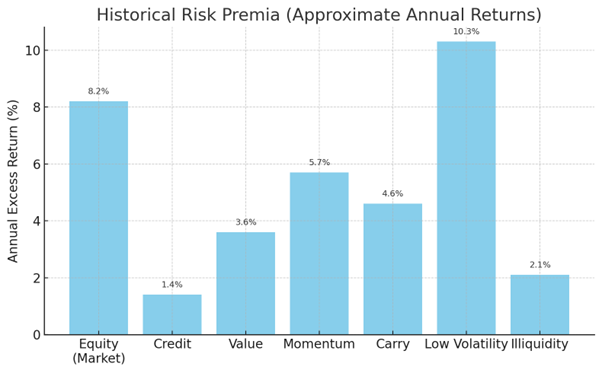
Historical average annual excess returns for various risk premia (long-run studies). “Equity” is the market portfolio vs. T-bills, “Credit” is corporate vs. Treasury bonds, etc. For example, U.S. stocks have earned about 5 – 8% per year over Treasuries (equity premium), while a broad currency carry trade earned 4 – 5% annually in one study. Note the surprisingly high return of a low-volatility stock strategy – an anomaly where lower-risk stocks outperformed higher-risk stocks. Illiquid assets show a modest premium (~2% or more) over liquid assets. These premia are averages – actual results vary by period and come with significant uncertainty.
As the figure suggests, different risk premia have different magnitudes and characteristics. The equity risk premium has been one of the largest and most reliable over more than a century (around 5% in many markets, albeit with huge variation year to year). Style premia like value and momentum tend to be smaller in absolute return but still meaningful (often 2 – 5% ranges), and importantly they are uncorrelated with the market at times offering diversification benefits. Some alternative premia like carry or volatility-selling can have high risk-adjusted returns (Sharpe ratios), but one must remember they may experience rare but severe downturns (e.g. carry trade blow-ups or option-selling losses).
Academic research from firms like AQR and others has emphasized that combining these premia can improve a portfolio’s risk/reward. Each premium represents a different “story”. They tend to pay off in different environments. For instance, momentum might do well when trends persist, while value might shine when there is a rebound in beaten-down assets. By harvesting multiple premia, an investor is not putting all their eggs in one basket. Indeed, studies have shown factors like value and momentum are negatively correlated (when value lagged in the 2010s, momentum was often working, and vice versa). A portfolio that includes equity, credit, value, momentum, carry, and others could therefore deliver a smoother ride than any single one alone.
It’s also worth noting that realized returns of premia can shrink if they become popular. Some evidence suggests factor returns have been lower in recent decades as strategies got more widely adopted. However, many premia (like equity, value, momentum) have persisted over very long periods and across many markets, implying they are rooted in fundamental investor behavior or risk preferences that are not likely to disappear completely.
How to Harvest Risk Premia in Practice
Knowing about a risk premium is one thing – capturing it in a real portfolio is another. Risk premia harvesting means systematically investing in ways that expose you to these rewarded risks. Here are some practical principles and methods for harvesting risk premia:
- Use Passive Index Funds or ETFs: The simplest form of risk premium is the equity premium – this can be harvested by just owning a broad stock index fund (like an S&P 500 or MSCI World ETF) over the long run. This gives you exposure to systematic market risk. Similarly, a broad bond index fund that includes corporate bonds will capture some credit premium compared to just holding Treasuries. Low-cost index funds are effective tools because they reliably deliver the market or factor exposure and leave more of the premium in your hands (rather than being eaten by fees).
- Factor and Smart-Beta Funds: In recent years, investment products have been developed to target specific style premia like value, momentum, quality, low-volatility, etc. These are sometimes called smart beta or factor ETFs. For example, there are value index funds that overweight stocks with low valuations (harvesting the value premium), momentum funds that buy recent winners, low-volatility funds that tilt to more stable stocks, and so on. Firms like iShares, Invesco, and Dimensional Fund Advisors offer such funds. By incorporating some of these, an investor can harvest premia beyond the standard equity and credit. Important: It’s wise not to go “all in” on one factor – instead, diversifying across several factors (and across asset classes) increases the chance that at least some premia are paying off at any given time.
- Long-Short vs. Long-Only: Many academic definitions of premia (like value or momentum) assume an idealized long-short portfolio (e.g. long cheap stocks, short expensive ones). Most individual investors will stick to long-only implementations (no shorting) for simplicity and practical reasons. Long-only factor funds still capture the essence of the premium, just perhaps not as pure as a long-short hedge fund would. For example, a value fund might just overweight value stocks and underweight (but not short) growth stocks. This can still capture a lot of the premium. The takeaway is: you don’t need a fancy hedge fund to harvest premia; many premia are accessible with plain long-only products.
- Alternative Assets/Strategies: Some premia require more specialized approaches. Carry trades and volatility-selling, for instance, are often executed by hedge funds or sophisticated investors using derivatives. However, there are some retail-friendly vehicles: e.g. certain currency ETFs let you take positions in high-yield vs low-yield currencies; or covered-call funds that effectively sell call options (harvesting volatility premium). If you’re a beginner/intermediate investor, it’s usually best to start with the straightforward premia (equity, credit, value, etc.) using traditional funds before venturing into complex strategy funds. Remember that higher complexity can mean higher hidden costs and risks.
- Rebalancing and Discipline: A critical practical component of harvesting premia is rebalancing. Because different assets and factors will grow at different rates, a set-and-forget allocation will drift over time. By periodically rebalancing (say annually or semi-annually) back to target weights, an investor is effectively selling some of what has outperformed and buying more of what has underperformed – which enforces a “buy low, sell high” behavior. Rebalancing thus helps in harvesting premia because it ensures you maintain exposure to each desired risk factor (and not let one dominate after a streak of good performance). It also provides a systematic way to capitalize on volatility and factor rotation. For example, if momentum has a terrible quarter and loses value, a disciplined rebalancer will end up adding to it when it’s relatively cheap, setting up for when the premium resurges. Without rebalancing, one might inadvertently abandon a premium at the worst time.
- Long Horizon and Patience: Practically, to harvest risk premia one must be long-term oriented. These premiums are called “risk” premia for a reason – there will be periods of loss or underperformance. One must be willing to endure those periods. For instance, if you tilt to value stocks, you have to tolerate possibly years of them lagging growth stocks (as occurred in the late 1990s and mid-2010s). If you are not committed, you might abandon the strategy at the bottom, missing the rebound (thus missing the premium when it manifests). Many investors fail to capture premia because they chase whatever had premium recently (buying high) and ditch it when it suffers (selling low). Successful risk premia harvesting flips that script: it’s systematic, contrarian when needed, and patient.
In summary, implementing a risk premia harvesting strategy usually means building a diversified portfolio that includes exposures to multiple rewarded risks. A practical portfolio for an individual might look like: a core of broad equity index (equity premium), some allocation to a value-oriented fund and a momentum fund (style premia), some allocation to an international or emerging market stock fund (possibly capturing geographic or additional risk premia), a core bond holding with some corporate bonds (credit premium), maybe a REIT or private assets slice (illiquidity premium), and perhaps a small sleeve for an alternative strategy like a managed futures fund (which often harvests momentum across asset classes) or an option-income fund (volatility premium). The exact mix depends on risk tolerance and access, but the guiding idea is diversification across independent sources of return.
Challenges and Risks in Harvesting Premia
If harvesting risk premia were easy, everyone would do it and reap excess returns effortlessly. In reality, several challenges make it difficult in practice, and these challenges are exactly why the premia exist:
- Volatility and Drawdowns: All risk premia come with… well, risk. This means returns are volatile and can be negative for stretches. The equity premium, for example, has infamously large drawdowns (half of your equity portfolio can vanish in a bad bear market like 2008 or 2020). The value premium saw a near 10-year drawdown through the 2010s. Momentum strategies periodically crash (e.g., a sudden trend reversal). Carry trades can unravel spectacularly in a financial crisis (e.g., 2008 saw the yen surge and carry traders were crushed). These painful episodes are the price one pays to earn the premia in the long run. Enduring them is hard. Many investors get shaken out, which ironically is what keeps the premium alive for those who stay.
- Behavioral Pitfalls: Humans are not wired to patiently endure underperformance or to buy more of what’s been losing. Behavioral biases – fear, greed, herding, overconfidence – all interfere with harvesting premia. For instance, value investing looks easy on paper (“buy cheap stocks”); but when those stocks keep getting cheaper and the news is screaming doom, many lose conviction. Likewise, a momentum strategy might feel wrong (“buy high?”) and if one does not trust the process, they might not stick to it. Successful premia harvesting often requires a rules-based approach to counteract our natural instincts. It may help to use automated or rule-governed funds to enforce discipline. Behavioral coaching or simply setting expectations that “this strategy will lag at times and that’s normal,” is crucial.
- Crowding and Changing Markets: Once a risk premium is well-known and many people chase it, its future returns could diminish. There’s debate on this: some argue that factors like value and momentum have lower returns now than in mid-20th century due to crowding. Others note that certain premia (like volatility selling) attract so much money that they occasionally experience overcrowded wipeouts (e.g. the “Volmageddon” episode in February 2018 when a popular short-vol ETN blew up). As more investors attempt to harvest a premium, the trade can get crowded, increasing correlations and tail risks. However, truly eliminating a premium would require everyone to permanently change behavior (e.g., for value to disappear, investors would have to never again shun cheap stocks en masse, which seems unlikely). Still, one should be aware that realized premia might be smaller going forward than in the past.
- Implementation Costs: Real-world frictions can eat into premia. Trading costs, management fees, taxes, and even liquidity constraints can reduce the net returns from a strategy. For example, momentum requires high turnover (frequent trading in and out of winners/losers), which in practice incurs costs possibly not seen in the academic “paper” returns. Funds that do carry trades or volatility selling charge fees that take a slice of the returns. It is important to seek efficient, low-cost implementation or else the premium could be arbitraged away by expenses. Fortunately, the rise of low-cost factor ETFs and index derivatives has made implementation cheaper than it once was, but it is still a factor to consider.
- Regime Changes: A risk premium is usually described “on average, over the long run.” But there is no guarantee that, say, the next 10 years will reward value or momentum just because the last 90 did. Economic regimes (inflation, growth, monetary policy, etc.) can influence factor performance. For instance, the equity premium might be lower in a world of ultra-low interest rates (if stocks and bonds become more correlated or if risk appetite structurally changes). The illiquidity premium could shrink if new technology suddenly makes illiquid assets more liquid (imagine a secondary market boom for private equity shares). Investors need to periodically assess whether the rationale for a premium still makes sense going forward. Generally, the premia we discussed are tied to fundamental aspects of markets and human behavior, so they are not expected to vanish overnight. But humility is warranted – there is no free lunch, and the future could always surprise.
Building a Diversified Risk Premia Portfolio
Given the challenges, how can one increase the odds of success in harvesting risk premia? The answer lies in thoughtful portfolio construction and risk management:
- Diversify Across Premia: This point cannot be emphasized enough – diversification is the “only free lunch” in investing. Each risk premium has distinct risks and will behave differently in various scenarios. By holding a mix of them, you reduce your portfolio’s reliance on any single source of return. In practical terms, this could mean a mix of stocks and bonds (equity + term + credit premia), and within stocks, a mix of style factors (some value, some momentum, maybe some quality/low-vol). You could also include a small allocation to alternatives like a commodities trend-following fund (harvesting momentum in a different arena) or real estate/private assets (illiquidity premium). The goal is that when one part of the portfolio is struggling, another might be doing well, or at least not as badly. Diversification across risk premia can substantially reduce volatility and tail risk at the portfolio level. Empirical studies (e.g., AQR’s research) have shown that a multi-style, multi-asset portfolio of risk premia can deliver higher risk-adjusted returns than any individual strategy.
- Avoid Over-Concentration: Sometimes investors inadvertently double up on the same underlying risk. For example, an investor might think they are diversified by holding a tech growth fund and a small-cap fund – but if both are tilted towards, say, growth stocks or high-beta stocks, they could both crash together. Ensure that your different premia exposures are truly differentiated. If you allocate 50% of your portfolio to various equity factor funds and 50% to the S&P 500, note that almost the whole portfolio is still equity risk (since factor funds mostly hold equities too). So look at the aggregate exposures – you might find you need some bonds or alternative strategies to balance out the equity risk. A simple rule of thumb is not to let any one risk (equity market risk, or any single factor) dominate your portfolio beyond what you can tolerate in a worst-case scenario.
- Regular Rebalancing: We discussed rebalancing as a practice; here it is as a policy. By setting target allocations to each asset/factor and rebalancing, you maintain your intended risk profile. Rebalancing also forces you to trim exposures that have grown (which likely means they have had strong recent returns and could be relatively expensive now) and add to laggards (which could be poised for a rebound). This contrarian action helps ensure you actually capture the long-term premia (which often accrue right after many want to give up on them). Decide on a reasonable frequency (annually is fine for most) or tolerance bands (rebalance when an allocation is off by more than X% from target). Keep it systematic.
- Risk Monitoring: Because multiple premia can have episodic bad outcomes (sometimes even simultaneously), it is important to monitor overall portfolio risk. Make sure you are comfortable with the worst-case scenarios. Stress test the portfolio: “What if stocks drop 40% and my credit and carry and momentum also all go wrong together – can I handle that? Will I stick with the strategy?” If not, de-risk until you can. It is better to have a slightly lower expected return than a portfolio that you will abandon at the bottom. Use historical data as a guide but also imagine scenarios that have not happened yet. The year 2020, for instance, saw an equity crash and a quick rebound that confused value/momentum rotations; 2022 saw stocks and bonds fall together (hurting the traditional 60/40 equity/bond mix). A diversified premia portfolio likely fared better in some of those scenarios, but always ask “what if many of my assumptions break down at once?”
- Stay Informed but Steadfast: Finally, education and conviction help. By understanding why each risk premium should exist (e.g., “I’m getting paid to hold this because others are unwilling or unable to”), you can build the fortitude to stick with it. Knowing the historical context – for example, that even after 10 years of drought, the value premium has roared back in the past – can help you avoid capitulating. It’s wise to keep up with current research (to ensure your strategies are grounded in evidence and to be aware of any structural changes). But avoid the trap of constantly tweaking or factor timing (jumping from one strategy to another based on short-term performance). The whole idea of premia harvesting is a long-term, systematic approach.
By following these principles, an investor can construct a portfolio that systematically tilts toward rewardable risks while managing the overall volatility. For a beginner-to-intermediate investor, one might start with a core diversified portfolio (like a global 60/40 stock/bond mix) and then introduce small tilts: e.g., 10% extra into a value fund, 10% into a quality or momentum fund, 5% into a REIT or private credit fund, etc., funded by slight reductions in the core. Over time, if comfortable, one could increase these tilts. The result is a portfolio that still looks similar to a balanced portfolio, but with an enhanced expected return through multi-premia exposure – essentially harvesting risk premia in a responsible way.
Final Thoughts and Further Reading
Risk premia harvesting offers a compelling approach to boosting returns: instead of trying to predict the next Apple or time the market’s ups and downs, you systematically expose your portfolio to structured risks that have proven long-run rewards. It is about being the one getting paid to underwrite certain risks that other investors either cannot take or will not take. However, as we have emphasised, those rewards do not come free – the ride can be bumpy and requires discipline, diversification, and patience. The good news for a curious investor is that decades of research and new investment products have made it more feasible than ever to pursue these strategies in a transparent, low-cost way.
For those interested in learning more, there are some excellent resources to deepen your understanding. Academic papers like Fama and French (1993) on the value and size premia, Jegadeesh and Titman (1993) on momentum, and Frazzini and Pedersen (2012) on the low-volatility (BAB) factor are foundational. Asset management firms have also published accessible white papers – for example, AQR Capital’s paper “Understanding Alternative Risk Premia” and Robeco’s various factor investing research. Books such as “Expected Returns” by Antti Ilmanen provide a comprehensive overview of numerous risk premia across asset classes (with historical evidence and theory). Additionally, the CFA Institute Research Foundation has a free literature review on the Equity Risk Premium, and sources like Research Affiliates regularly post articles examining factor performance (e.g., “The Incredible Shrinking Factor Return”, which discusses how factor returns in practice can differ from theory).
By continuously educating yourself and staying aware of both the data and the behavioural aspects of investing, you can become better equipped to harvest risk premia successfully. Remember, harvesting risk premia is a marathon, not a sprint – but for the patient investor, it can be a rewarding journey. Armed with an understanding of systematic vs. idiosyncratic risk, the major types of premia, and the tools to capture them, you are well on your way to investing not just harder, but smarter.
If you made it to the end of article – congratulations! Don’t worry if not everything makes sense right away as long as you now have a basic of what risk premia are and why it might be a sensible strategy to harvest these. Next week I will publish a post explaining what steps to take to actually get started with risk premia harvesting.