
A Note to Parents
Compounding is one of the most powerful forces in finance – and one of the hardest to appreciate without seeing it in action. For kids, it’s like magic: the longer your money sits and grows, the bigger it gets. Not because you keep adding more, but because it starts growing on its own.
A Story for Kids: Stoffel the Monkey and the Growing Coins
Once upon a time, in a sunny jungle, there lived a little monkey named Stoffel. Stoffel was curious, clever – and a little obsessed with shiny coins.
One day, Stoffel’s grandpa gave him 1 magic coin. “Put this coin in your coconut bank,” he said, “and wait one day. Tomorrow, it will grow into 2 coins.”
“Wow!” Stoffel said. He put the coin away and waited.
The next day, there were 2 coins in the coconut. “It worked!” Stoffel cheered.
But something even cooler happened the day after. The 2 coins turned into 4 coins.
And the next day? 8 coins.
Then 16… then 32… and it kept going!
What’s Happening Here?
The coins were growing by doubling each day. But here’s the trick: the new coins grew coins too!
That’s called compounding – when your money earns more money, and the money it earned also starts earning more.
It’s like a snowball rolling down a hill. At first, it’s tiny. But the farther it rolls, the bigger it gets.
A Garden Example
If the jungle coins feel too wild, here’s another way to think about it:
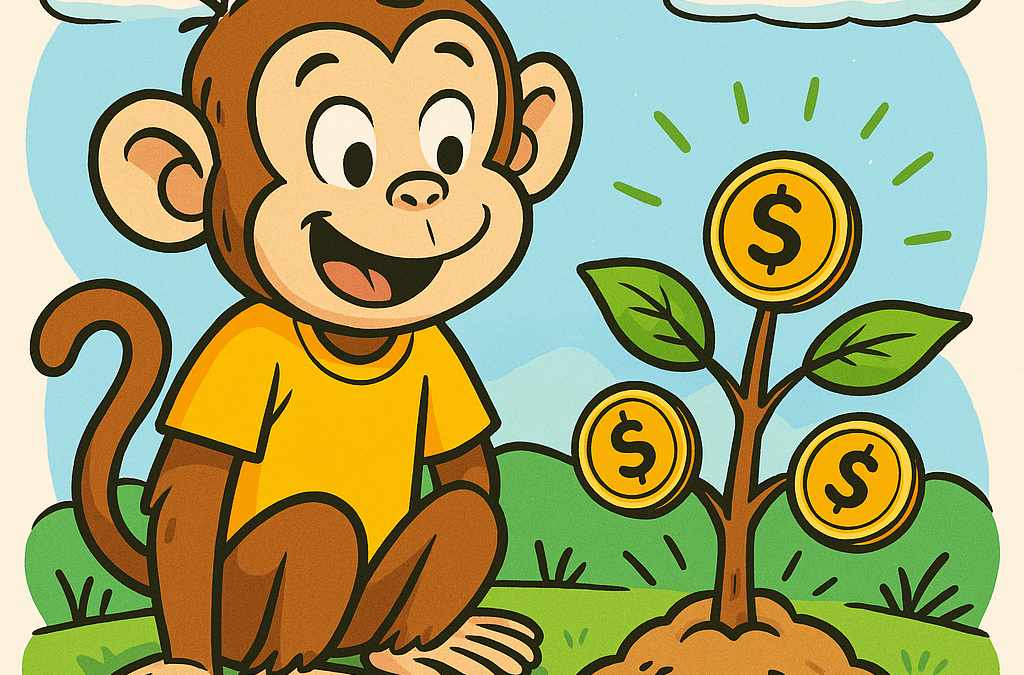
Imagine you plant 1 money seed in your garden. After a while, it grows into a little money tree with 2 seeds. If you plant both of those, you’ll get more trees with more seeds…and soon your whole garden is full of money trees!
But here’s the thing: you have to wait.
If Stoffel had spent his coins after just 2 or 3 days, he never would’ve seen the magic. Compounding needs time and patience to work.
In the real world, money does not double overnight, but even a small, steady rate of growth, repeated year after year, adds up to something remarkable. Here’s a simple example:
Real Life Example (Simple Math)
Let’s say your child saves 10 coins.
- After a year, if it grows by 10%, they have 11 coins.
- The next year, 10% is now earned on 11 coins, so they have 12 coins and a bit.
- Then a little more…then a little more still.
- After 10 years of growing at 10% a year, those 10 coins become over 25 coins without adding anything extra.
What You Can Say to Your Child
- “Money can grow if we give it time like planting seeds and letting them grow into trees.”
- “The earlier you start saving, the more time your money has to grow.”
- “You don’t need a lot to start. Even small amounts grow big over time.”
Final Thought
The best way to teach compounding is to show it in action. You could:
- Start a real or pretend “coin garden” together with a small savings jar
- Use a sticker chart to show weekly growth
- Talk about how saving now means “future you” gets a reward
Kids don’t need to understand the math behind compounding. They just need to understand that waiting brings rewards. And the earlier they start grasping the idea of compounding the better for them and their future.
If you would like to see how compounding plays out over a lifetime of saving, I have written a more detailed guide for adults: The Quiet Force: How Compounding Turns Time into Wealth. A good read for parents who want to understand the numbers behind what they are teaching.
If you are just getting started, the Money Foundations for Kids miniseries covers saving vs spending, needs vs wants, budgeting, and where money comes from:
Part 1: Save or Spend? Helping Kids Make Smart Money Choices
Part 2: Needs vs Wants: Helping Kids Make Smart Money Choices
Part 3: What Is a Budget? (For Kids!)
Part 4: Where Does Money Come From? (And Why It Doesn’t Grow on Trees)