
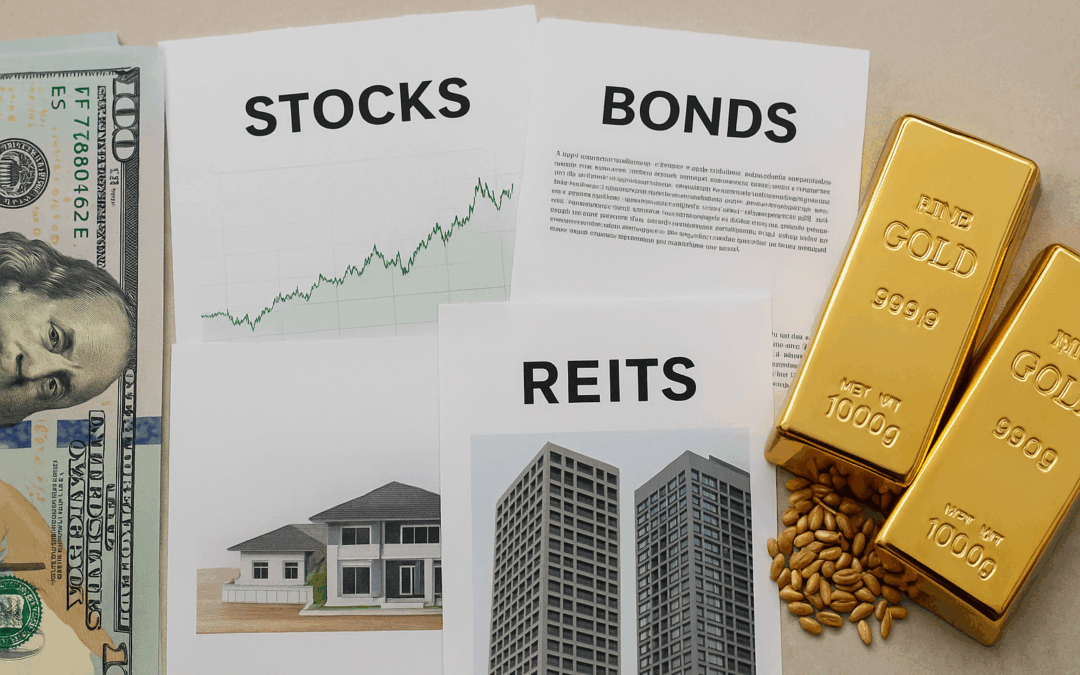
A Complete Guide to the Building Blocks of a Modern Portfolio
Over the past weeks, we explored the major asset classes that form the foundation of a retail investor’s portfolio. From the safety of cash to the growth engine of stocks, from income-producing bonds and REITs to the real-world diversification of commodities, each asset class plays a different role and understanding these roles is essential for long-term success.
This summary brings all posts together in one place, recaps the core ideas, and outlines where the series will go next.
The Major Asset Classes for Retail Investors
A well-constructed portfolio typically includes exposure to several of the following core asset classes. Each has distinct characteristics, different risk/return profiles, and a unique job to do.
Below is a short recap of each category with a link to the full article.
1. Cash & Cash Equivalents
Role: Stability, liquidity, capital preservation
Examples: Savings accounts, treasury bills, money market funds
Cash is the simplest and safest asset class. It won’t make you rich, but it protects your downside and gives you the flexibility to act when opportunities arise.
👉 Read the full guide: https://stoffelwealth.com/asset-classes-cash-cash-equivalents/
2. Stocks (Equities)
Role: Long-term growth, ownership in businesses
Examples: Individual stocks, ETFs, equity mutual funds
Stocks are the engine of wealth creation. Over time, they deliver the highest returns of all major asset classes but with significant volatility along the way.
👉 Read the full guide: https://stoffelwealth.com/asset-classes-stocks/
3. Bonds (Fixed Income)
Role: Income, stability, diversification
Examples: Government bonds, corporate bonds, bond ETFs
Bonds act as the ballast of a portfolio. They generate steady income, cushion stock market drawdowns, and help reduce overall volatility.
👉 Read the full guide: https://stoffelwealth.com/asset-classes-bonds/
4. REITs (Real Estate Investment Trusts)
Role: Income generation, real-asset exposure, inflation protection
Examples: Retail REITs, data centers, industrial REITs, healthcare REITs
REITs allow investors to benefit from the income and resilience of real estate without buying physical property. They offer attractive dividends and diversification benefits.
👉 Read the full guide: https://stoffelwealth.com/asset-classes-real-estate-investment-trusts/
5. Commodities
Role: Diversification, inflation hedge, exposure to real-world demand
Examples: Gold, oil, natural gas, agricultural products, metals
Commodities represent the raw materials that power the global economy. They are volatile and cyclical but play a strategic role during inflation and economic stress.
👉 Read the full guide: https://stoffelwealth.com/asset-classes-commodities
What This Series Helps You Understand
By working through each asset class, you now have a framework to understand:
- How different assets behave in various market conditions
- Which risks and return drivers matter most for each asset class
- How different assets complement one another
- How to build a diversified portfolio aligned with your goals
- Why no single asset class can do everything
With these fundamentals, you are better positioned to make informed investment choices and to build a resilient long-term strategy.
What’s Next: Expanding the Series
The investment universe is broader than these five traditional asset classes. In future posts, we will expand the series into emerging and alternative asset categories that are becoming increasingly relevant for modern investors:
Potential Upcoming Topics
- Cryptocurrencies & Digital Assets
Beyond Bitcoin: blockchain-based assets, stablecoins, tokenization, and risks. - Venture Capital & Private Equity
High-risk, high-return opportunities typically reserved for accredited investors; how retail investors can access them. - Private Credit
Direct lending, floating-rate exposure, and how this growing market fits into an income-focused portfolio. - Infrastructure
Toll roads, airports, utilities, renewable energy projects, and why these assets offer long-term, inflation-linked cash flows.
These will complement the existing posts and help complete your understanding of the broader investment landscape.
Leave a comment below if you are interested in a specific asset class.
Final Thoughts
Building wealth is not about picking the hottest asset, it’s about understanding how different assets work together.
With this series, you now have a clear picture of the foundational building blocks of a portfolio and how each contributes to long-term financial resilience.
Stay tuned as we continue to explore the investment universe one asset class at a time, helping you build a smarter, stronger, and more diversified financial future.