
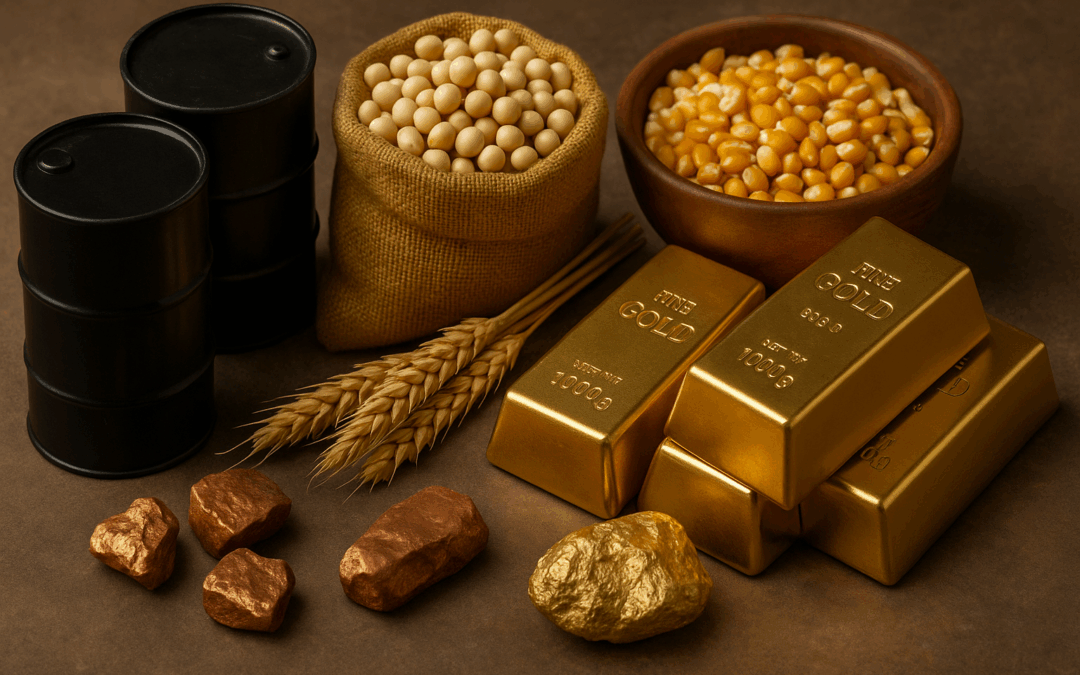
The Earth’s Raw Wealth – Investing in What the World Needs
While stocks and bonds power the financial world, commodities represent the Earth’s essential building blocks: energy to fuel industries, metals to build infrastructure, and food to feed billions.
This asset class connects your portfolio to the physical economy, offering diversification and potential inflation protection but also bringing its own wild cycles and unique risks.
In this post, we will unpack what commodities are, explore their key types, practical ways to invest, and how they fit into a modern portfolio.
What Are Commodities?
A commodity is a raw material or primary agricultural product that can be bought and sold.
Unlike stocks (ownership in a business) or bonds (a loan), commodities are tangible stuff: physical inputs that meet fundamental human needs.
They are also standardized, meaning one barrel of oil or one ounce of gold of the same grade is interchangeable with another.
Key distinctions include hard commodities (extracted/mined, like metals and energy) and soft commodities (grown, like crops and livestock).
Key Categories of Commodities
|
Type |
Examples |
Distinctive Traits |
|
Energy |
Oil, Natural Gas, Coal |
Drives industry and transport; highly cyclical |
|
Metals |
Gold, Silver, Copper, Platinum |
Industrial use and inflation hedge; scarce |
|
Agriculture |
Wheat, Corn, Coffee, Soybeans |
Weather-dependent; globally essential |
|
Livestock |
Cattle, Pork |
Food supply; cyclical patterns |
These categories form the backbone of the global economy, each responding differently to growth, inflation, and geopolitical shifts.
Major commodity price movers include weather events (droughts, hurricanes), wars, sanctions, regulatory export bans, and technological change such as EVs altering demand for lithium or cobalt.
Why Invest in Commodities?
Commodities play a distinct role in diversified portfolios, particularly during inflationary or uncertain periods.
- Diversification: Low correlation with equities and bonds; often rise when traditional assets fall.
- Inflation Protection: Prices of raw materials tend to increase when inflation heats up.
- Exposure to Global Demand: Growing economies drive demand for energy, metals, and food.
- Tactical Opportunity: Supply shortages, wars, or weather events can create strong short-term trends.
The Risks of Commodities
Their potential rewards come with considerable complexity and volatility.
|
Risk |
Explanation |
|
Volatility |
Prices swing dramatically with weather, politics, or speculation. |
|
No Income |
Commodities don’t produce dividends or interest; returns come solely from price changes. |
|
Supply Shocks |
Wars, droughts, and disruptions can cause sudden spikes or crashes. |
|
Storage & Logistics |
Holding physical commodities is expensive and impractical for most investors. |
|
Regulatory Risk |
Governments can intervene heavily in commodity markets. |
|
Leverage/Derivative Risk |
Futures and options amplify both gains and losses. |
How to Invest in Commodities
Retail investors can gain exposure in several ways, each with trade-offs.
- Physical Ownership
- Buy gold or silver bullion directly.
- Tangible but requires secure storage, impractical for most commodities.
- Commodity Exchange Traded Funds (ETFs) & Exchange Traded Notes (ETNs)
- Track prices via futures or physical holdings.
- Notable examples: SPDR Gold Shares (GLD), United States Oil Fund (USO), Invesco DB Agriculture Fund (DBA).
- Liquid, accessible, and storage-free but watch out for roll costs and fees.
- When contracts are rolled forward in futures-based funds, investors may lose if near-term contracts are cheaper than longer-dated ones (contango).
- Commodity Futures & Options
- Contracts to buy/sell commodities at future dates.
- High risk and complexity, suited for professionals.
- Equity Exposure (Indirect)
- Invest in commodity-producing firms (miners, energy companies, agribusinesses).
- Adds business and management risk but easier to access.
- Multi-Asset or Alternative Funds
- Some balanced or risk-parity funds include commodity allocations.
- Provide diversification without direct commodity trading.
How Commodities Fit into a Portfolio
- Alternative Sleeve: Typically, 0 – 10% allocation depending on goals and risk appetite.
- Inflation Hedge: Increase exposure during inflationary or stagflation periods.
- Tactical Diversifier: Offsets stock/bond underperformance during supply shocks or crises.
- Not for Income: Commodities protect purchasing power but don’t produce cash flow.
Some investors prefer indirect exposure through commodity-producing equities or structured notes for smoother returns.
Final Thoughts: Rooted in the Real Economy
Owning commodities is like investing in the engine room of civilization: oil that moves goods, metals that build cities, and grains that feed the world.
They are not always glamorous and can test your patience with volatility, but in times of inflation and uncertainty, commodities bring resilience and balance to your portfolio.
Used wisely, they anchor your investments in the real economy, hedging risks that financial assets alone cannot. It’s wealth with roots, grounded in the very materials that make modern life possible.