
Every investor hears about “timing the market”: trying to buy low and sell high, hopping in and out based on forecasts. It sounds smart. It feels proactive. But the reality is much tougher.
One of the most powerful lessons from nearly a century of stock-market history is this: bull markets last far longer than bear markets, and the best days often come right after the worst ones. If you try to avoid the bad days, you’re also likely to miss the best ones. That’s why time in the market beats timing it.
In this article, we look at the patterns of bull and bear markets in US markets and what they teach long-term investors about being patient and staying invested.
What are Bull and Bear Markets?
- Bear Market: A period when the market falls substantially (commonly defined as a drop of 20% or more from a recent high).
- Bull Market: The recovery and growth phase from the bear market low to a new peak. The market is rising and investor sentiment is generally upbeat.
The exact definitions and thresholds can vary slightly depending on whether one looks only at price, total return (price + dividends), or adjusts for inflation. But broadly, the cycle is trough → recovery → peak → decline → trough, and repeat.
Historical Patterns: Duration and Returns
Here’s what history tells us about how long these cycles last and how big the gains/losses are based on key data from the S&P 500 and other U.S. markets:
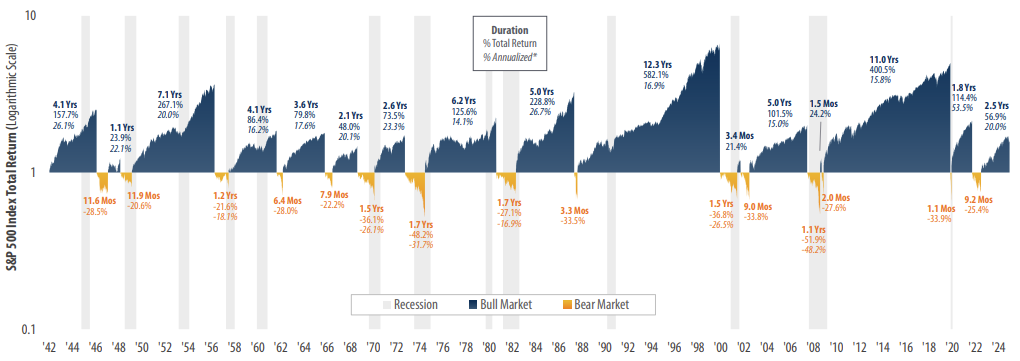
- According to First Trust, since 1942, the average bull-market period lasted about 3 years, delivering a cumulative gain of ~149.5%.
- In the same study, the average bear-market period lasted about 1 months, with a cumulative loss of ~-31.7%.
- A study from Stifel shows slightly different numbers: average bull markets lasting ~4.9 years with a cumulative gain of 177.6%, average bear markets ~1.5 years, with loss magnitude around –35%.
- According to Russell Investments, over long periods, bull markets have been more frequent and much more powerful in cumulative gains compared to losses in bear markets.
- A more recent figure from Nasdaq / Bespoke: the average S&P 500 bull market from 1929-2023 lasted ~1,011 days (~2.8 years), whereas the average bear market lasted ~286 days (~0.8 years).
- Bear markets are less common than bull markets: since World War II, there have been fewer bear markets than bull markets, and bear markets tend to be shorter.
- The shortest bear market in the S&P 500 was the March 2020 COVID-19 crash, which lasted only about 33 trading days. But despite its brevity, the drop was severe.
- Full market recoveries (i.e. the time taken to return to the previous high) can take months or years after a bear market ends.
What the Patterns Mean for Investors
1. Bull Markets Drive the Gains
Because bull markets last longer and tend to deliver large cumulative returns, much of an investor’s lifetime gains come during the “good times.” Missing those strong recovery or rapid-growth days can cut your returns significantly.
2. Bear Markets Are Inevitable but Usually Manageable
Market declines happen. But they tend to be shorter than the good periods. Historically, markets have recovered from downturns and gone on to make new highs. Staying invested (rather than fleeing at the first signs of trouble) has often paid off in the long run.
3. Timing the Market Requires Great Luck and Accuracy
To benefit from market timing, you need to:
- Exit before significant losses (i.e. predict the start of the bear market), and
- Re-enter before most of the recovery gains occur. Because the best days often follow the worst days, pulling out too early or re-entering too late can mean you miss much of the upside.
4. Patience and Discipline Matter More Than Forecasting Accuracy
If you do regular investing (e.g. via dollar-cost averaging), and if you hold through volatile periods without panicking, you’re more likely to capture growth than trying to jump in/out based on market calls.
Visualizing the Cycles
The following graph visualizes the history of bear and bull markets in the S&P 500 since 1942 and clearly shows the magnitude of past bull markets vs. bear markets:
Source: First Trust
Conclusion: Time in the Market Beats Timing It
The history of markets isn’t smooth, but it is upward-tilted. There will be setbacks, but they are typically shorter than the upward phases and recoveries.
Because so much of the lifetime return comes from only a fraction of trading days (often during or just after recoveries), trying to avoid downturns often means missing out on those powerful upward moves.
Thus, instead of obsessing over when to get out or in, your energy is better spent on:
- staying invested over long periods
- keeping a well-diversified portfolio
- using regular investment contributions
- avoiding emotional overreaction to short-term market moves.
If you’re investing for decades, time is your greatest ally, not timing.