

Once you have settled on a simple ETF strategy, one question tends to come up quickly: should I focus on dividend-paying investments, or just go for total return? The question seems simple. The answer depends on things most dividend content never mentions.
Dividend investing has genuine appeal. Regular income feels tangible in a way that unrealized portfolio growth does not. It is psychologically easier to hold through a downturn when the income keeps arriving. And for investors approaching or in retirement, dividends can serve a practical cash-flow purpose.
But the case for dividends is also frequently overstated – and for international investors, tax treatment can quietly erode much of the advantage. Here is what you actually need to know.
What a Dividend Actually Is
A dividend is a distribution of a company’s profits to its shareholders. When a company pays a dividend, its share price falls by approximately the dividend amount on the ex-dividend date. You have not received something extra – a portion of the company’s value has been transferred to you in cash.
This is the core insight that reframes the entire dividend debate: a dividend is not free money. It is a mechanical transfer of value from the share price to your account. A stock worth 100 that pays a 3 dividend is worth 97 after the payment. Your total wealth is unchanged before taxes – and after taxes, it is slightly lower.
This does not mean dividends are bad. It means they are not a bonus on top of returns – they are part of the return, extracted in a specific form.
Total Return vs Dividend Income
Total return is the combination of price appreciation and dividends received. Two investors who hold identical portfolios – one that pays dividends and one that reinvests them – will arrive at the same total return before taxes. The difference is timing and form: one receives cash along the way, the other accumulates it inside the fund.
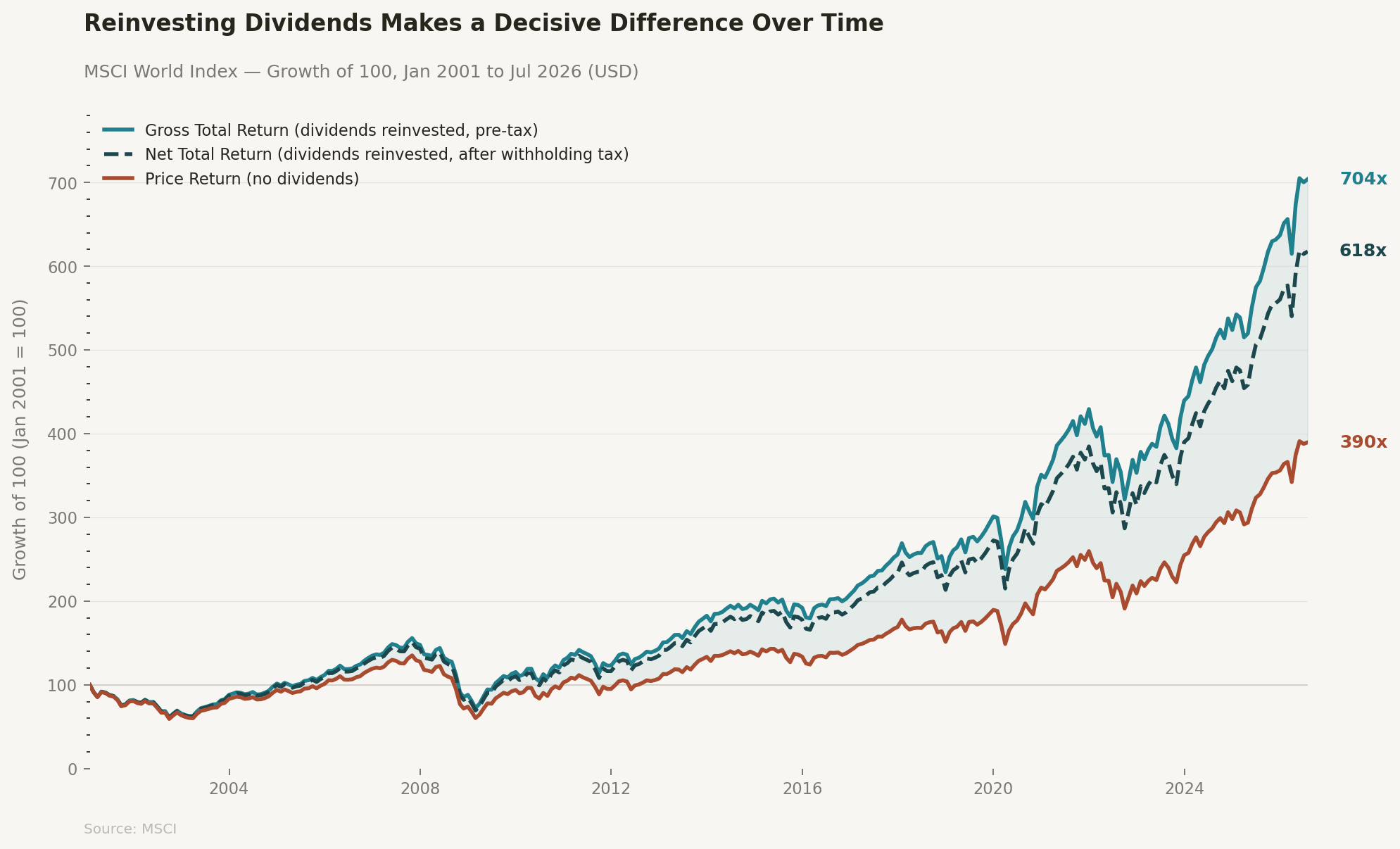
The chart below makes this tangible. Using MSCI World index data from January 2001 to July 2026, it compares three scenarios:
- price return only (no dividends),
- net total return (dividends reinvested after withholding tax), and
- gross total return (dividends reinvested before any tax).
An initial investment of 100 grows to 390 in the price-only scenario – and to 618 under net total return. That gap of 228 percentage points is the cost of not reinvesting dividends over 25 years.
For an investor in the accumulation phase – still building wealth rather than drawing it down – there is no inherent advantage to receiving dividends. In fact, if those dividends are taxed on receipt, a distributing fund is at a disadvantage compared to an accumulating one. The tax reduces the amount available to compound.
The case for dividends strengthens when you need the income. In retirement or early financial independence, receiving regular distributions removes the need to sell shares to fund living expenses – which can be psychologically easier and sometimes practically useful depending on your withdrawal strategy.
Accumulating vs Distributing ETFs
Most major UCITS ETFs come in two versions:
- Accumulating (Acc): dividends received by the fund are automatically reinvested inside the fund. No cash is paid out. In most jurisdictions, there is no taxable event until you sell.
- Distributing (Dist): dividends are paid out to you as cash, typically quarterly or semi-annually. These are usually taxable in the year you receive them.
Both versions hold the same underlying assets and generate the same gross return. The difference is entirely in when and how tax is triggered.
For most investors in the accumulation phase, an accumulating ETF is the more tax-efficient choice. Tax deferred is tax that stays invested and keeps compounding. The exception is jurisdictions that impose annual notional taxation on accumulating funds regardless of distributions – in which case the advantage narrows or disappears.
The practical rule: check your local tax treatment before choosing between Acc and Dist. The answer is not universal.
Dividend Withholding Tax for International Investors
This is where dividend investing becomes significantly more complex for non-US investors – and where the appeal of high-yield dividend ETFs often breaks down.
When a US company pays a dividend, the US government withholds tax at source before it reaches you. For non-US investors holding US-domiciled ETFs, this withholding rate is typically 30% — reduced by tax treaty for investors in treaty countries but rarely eliminated entirely.
UCITS ETFs domiciled in Ireland largely solve this problem. Ireland has a favorable tax treaty with the US, so Irish-domiciled ETFs receive US dividends with a 15% withholding rate rather than 30%. This treaty benefit is embedded in the fund – you benefit from it automatically, regardless of your own country’s treaty position.
The implication: for international investors building a global equity portfolio, Irish-domiciled UCITS ETFs are generally more tax-efficient on dividends than direct US-listed ETFs, even before considering US estate tax exposure.
The Dividend Growth vs High Yield Trade-off
Within dividend investing, there is an important distinction between two strategies:
- High dividend yield: selecting companies or ETFs that pay the highest current dividend. These tend to skew toward mature, capital-light sectors: utilities, telecoms, financials. The risk is that high yields can signal stress – a company with a falling share price and a maintained dividend will show an elevated yield, but the underlying business may be deteriorating.
- Dividend growth: selecting companies with a track record of consistently growing their dividend over time. The starting yield is usually lower, but the income stream compounds. Companies that grow dividends reliably tend to be financially disciplined and profitable over long periods.
For long-term investors, dividend growth tends to produce better outcomes than chasing yield. A 2% yield that grows at 8% annually becomes a significantly higher yield on your original cost basis over a decade – and typically comes with stronger capital appreciation as well.
When Does Dividend Investing Make Sense?
Dividend investing is not better or worse than a total return approach – it is appropriate in different circumstances.
- You are in or near the decumulation phase and want regular income without selling shares
- You find the psychology of receiving income easier to sustain through market volatility
- Your tax situation makes distributing funds neutral or advantageous relative to accumulating ones
- You are building a portfolio where cash flow matters, such as a supplemental income strategy alongside a full-time income
It is a less obvious fit if you are in the accumulation phase, pay tax on dividend income in the year received, and do not need the cash flow. In that case, an accumulating total market ETF is likely to deliver the same or better outcome with less tax drag.
Final Thoughts
The dividend vs total return debate is often framed as a values question – income investors versus growth investors. In practice, it is a tax and cash flow question. The underlying math is the same either way.
For most investors building wealth over the long term, an accumulating global equity ETF – benefiting from the full compounding of reinvested dividends with deferred tax – is the simpler and often more efficient path. If and when you need income, switching to distributing funds or supplementing with dividend-focused ETFs is straightforward.
Summary:
- A dividend is not free money; it is value transferred from the share price to your account
- Total return is identical before taxes; after taxes, accumulating ETFs often win in the accumulation phase
- Irish-domiciled UCITS ETFs reduce US dividend withholding tax from 30% to 15%
- Dividend growth tends to outperform high yield over the long term
- Dividend investing makes most sense when you need income or the psychology helps you stay invested
Are you drawn to dividends for the income, the psychology, or both – and has your thinking changed as your portfolio has grown?