
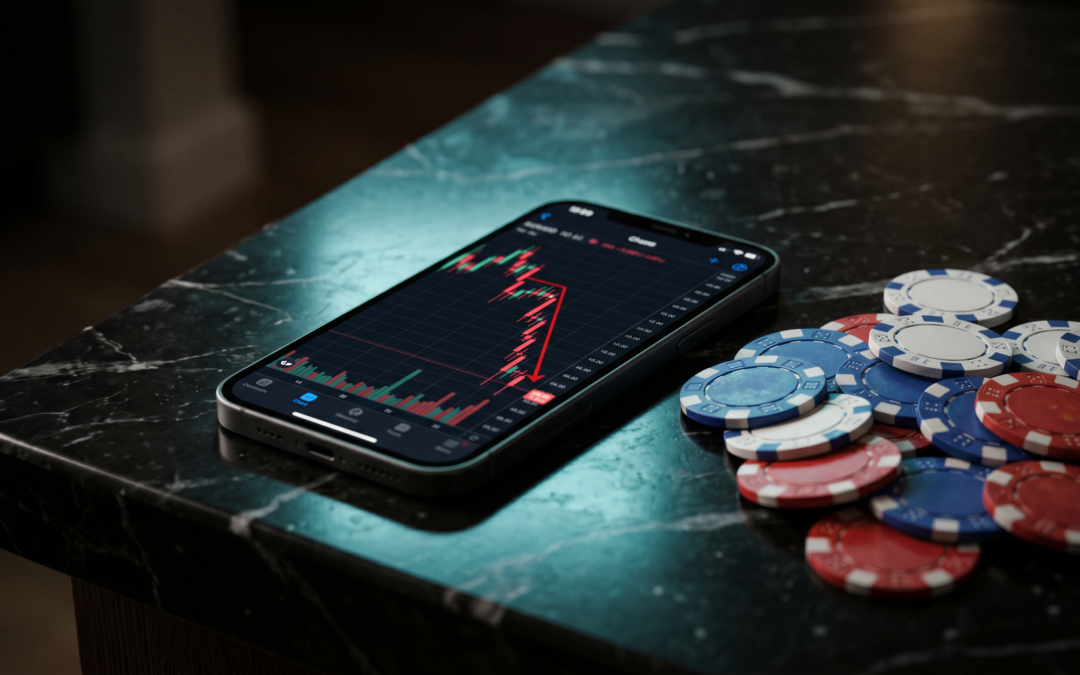
In June 2020, a 20-year-old student named Alex Kearns logged into his Robinhood account and saw a balance of negative $730,165. He had been trading options – complex instruments he did not fully understand – and the figure on the screen, which turned out to be a temporary display error, convinced him he owed more money than he could ever repay. He left a note asking how a platform had let someone his age, with no meaningful experience, take on that kind of risk. Then he took his own life. His family later settled a wrongful death lawsuit with the platform.
Alex’s story is extreme. The underlying pattern is not. Ordinary people are being drawn into instruments they do not understand, losing money they cannot afford, and finding they cannot stop. The apps feel like games. The products feel like bets. And the outcomes, in aggregate, look nothing like investing.
This is a piece I did not enjoy writing, because I know people who trade actively and I do not want to lecture them. There are successful active traders in the world and I myself am a member of a community of quantitative traders who are actively exploiting trading inefficiencies.
But the evidence from academic research, regulators on three continents, and clinical psychology is overwhelming and one-directional. Short-term active trading destroys wealth for the overwhelming majority who attempt it. The platforms are designed to encourage the behavior that loses you money. And a meaningful share of active traders develops symptoms clinically indistinguishable from gambling addiction. None of that is opinion. It is what the data shows.
The numbers are not ambiguous
Start with the most rigorous study of retail day traders ever conducted. Researchers at the São Paulo School of Economics followed 19,646 individuals who actively day-traded Brazilian equity futures, one of the largest markets of its kind in the world. The results, published on SSRN, are blunt:
- 97% of those who persisted for more than 300 days lost money.
- Only 1.1% earned more than the Brazilian minimum wage (roughly $16 a day).
- Only 0.5% earned more than a bank teller.
- Performance did not improve with experience. There was no detectable learning curve.
The authors were careful: these were not people who tried trading for a week and quit. These were people who stuck with it long enough to be considered serious. The evidence for “getting better at it” simply is not there.
The pattern holds across markets and regulators. The European Securities and Markets Authority, in its 2024 review of leveraged retail products, found that 74% to 89% of retail clients trading Contracts for Difference (CFD) lose money, with average account losses ranging from €1,600 to €29,000 depending on the jurisdiction. Broader meta-reviews of day-trading studies converge on a range of 80 to 95% of participants losing money. In retail foreign-exchange circles, traders have a grim shorthand for what happens: the “90-90-90 rule”: 90% of traders lose 90% of their capital within 90 days.
These are not edge cases. This is the typical outcome.
The derivatives explosion: more access, more complexity, more damage
If the base rate of loss among day traders is already this bleak, the instruments retail investors are now trading have made it worse. According to Cboe’s 2025 year-end review, the US options market just printed its sixth consecutive record year:
- 2 billion options contracts traded in 2025, up 26% year-on-year.
- Average daily volume of roughly 61 million contracts, with a single-session record of 110 million on 10 October 2025.
- Zero-days-to-expiry (“0DTE”) options grew from under 25% of S&P 500 options volume in 2021 to 59% in 2025.
- Retail options activity reached a record 21.7% of total US market volume in January 2026.
A zero-DTE option is a contract that expires the same day it is bought. It is a short-odds bet on the direction of a stock or index within the next few hours. If the market does not move the way you hoped, by the closing bell it is worth nothing at all. These are, functionally, the closest thing in regulated financial markets to a lottery ticket and retail investors now account for more than half of the short-dated contracts traded.
There is nothing wrong with options as a hedging tool in the hands of someone who has genuinely understood them. That is not who is driving this volume. The growth is in same-day speculation, and the math of those bets, with small premium, binary outcome, time decay measured in minutes, is structurally hostile to the buyer.
The app is designed to make you trade more
You might assume the trading apps are neutral plumbing. They are not. Regulators have now run proper controlled experiments, and the findings are consistent.
The UK Financial Conduct Authority ran an experiment with more than 9,000 consumers across simulated trading environments:
- Push notifications increased the number of trades by 11%.
- Prize draws linked to trading increased trades by 12%.
- Both nudges increased risky trading by 6 to 8%.
- The worst effects fell on young adults (18 – 34 years) and on investors with low financial literacy; exactly the people least able to absorb the losses.
The Ontario Securities Commission replicated the result with a randomized controlled trial involving 2,430 participants. Awarding points for trading produced 39% more trades than a control group. A “top traded” leaderboard made participants 14% more likely to herd into the same stocks. A follow-up study by the Behavioral Insights Team found that copy-trading features and social feeds had the largest effects of all.
Robinhood, the emblem of the category, has been caught using essentially every technique in that playbook. In January 2024 it agreed to pay $7.5 million to Massachusetts to settle claims that its app design had harmed investors. The documented features included:
- A confetti animation after a customer’s first trade.
- A lottery-scratch reveal for free stock rewards.
- A “tapping” game where users tapped the screen up to a thousand times a day to climb a waitlist.
- Emoji push notifications promoting specific stock lists.
- Customers with no prior investment experience averaging more than five trades a day.
The US Securities and Exchange Commission had proposed a rule to regulate predictive algorithms in trading apps; it was withdrawn in June 2025. The regulatory gap remains. The apps are engineered to maximize trading frequency. Your long-term wealth is maximized by doing roughly the opposite. Those two objectives are in direct conflict, and one of them is funded by a multi-billion-dollar industry.
When trading becomes addiction
This is the part of the story that is most underreported, and in my view the most important.
A November 2025 review in Psychology Today summarised the clinical literature as follows: roughly 8% of people who participate in financial markets meet screening criteria for problem gambling. A 2023 study of retail high-frequency traders found 6.7% met diagnostic criteria for gambling disorder. Dutch data puts the figure for compulsive gambling behaviour among retail investors at around 4.4%.
The neurobiology is the same as gambling:
- Dopamine reward circuitry activated by intermittent, unpredictable wins.
- Illusion of control: the belief that skill is driving outcomes that are largely random.
- Loss-chasing: increasing bet size to recover what has been lost.
- Tolerance: needing to trade larger amounts to feel the same buzz.
- Withdrawal: restlessness and irritability when unable to trade.
Trading disorder is not yet a formal diagnosis in diagnostic systems for mental health (DSM-5, ICD-11), but a Trading Disorder Scale has been developed, and clinicians are already treating cases with the same protocols used for gambling disorder, e.g. cognitive behavioural therapy. The comorbidities are the same too: anxiety, depression, and elevated suicidality. Research at Ball State University has shown a direct statistical link between portfolio losses and increased antidepressant use. A 2025 NIH review found that people with gambling disorder were 5.5 times more likely to have a substance use disorder and 3.7 times more likely to have a mood disorder than the general population.
This is not a character flaw in the people who develop it. It is a predictable neurological response to an environment that has been engineered, at considerable expense, to produce exactly this response.
The trading-course industry: selling the dream
The authors of the Brazilian study noted that their findings produced a “strong repercussion” among YouTube trading course providers. It is not hard to see why. An entire cottage industry is built on the premise that day trading is a learnable skill that can generate consistent income; a premise that the best available evidence flatly contradicts. Performance did not improve with experience. Persistence did not reward the persistent.
If you trace where the money reliably flows in retail day trading, it goes to:
- The platforms, through payment for order flow.
- The brokers, through commissions and bid-ask spreads.
- The options market makers, through the structural edge in pricing short-dated contracts.
- The course sellers, whose income comes from tuition fees rather than from trading.
That is not a conspiracy theory. It is simply where the cashflows end up. Retail traders are, in aggregate, the product.
What investing actually looks like
The antidote is almost boring by comparison. Investing, properly understood, is not about making daily decisions. It is about making one or two good decisions and then leaving them alone:
- Save a fixed percentage of every paycheque automatically, before you see it.
- Hold an emergency fund so you are never forced to sell at the wrong moment.
- Put long-term money into broadly diversified, low-cost index funds.
- Then, as much as possible, do nothing.
The entire discipline of long-term investing is, at its core, about resisting the urge to act. Which is precisely the urge that a well-designed trading app is engineered to create. If your platform profits when you trade more, through spreads, order flow, or premium subscriptions, its commercial interests run in the opposite direction from yours. Notice that, and a lot of the noise on your screen starts to look different.
A closing reflection
The house does not always win in investing. Broadly diversified equity markets, held over long enough horizons, have reliably rewarded patient and disciplined investors. The house almost always wins in active trading: not because markets are rigged, but because the math of trading costs, spreads, taxes, time decay and cognitive biases makes consistent retail profitability essentially impossible. The evidence is no longer in dispute. Only the marketing is.
So before you open the next position, it is worth asking yourself, honestly: am I investing, or am I gambling – and does the difference matter to me?
Final Thoughts
- Roughly 80% to 97% of active day traders lose money, depending on the market and the study. Experience does not fix this.
- Zero-day options and leveraged CFDs are not investments. They are high-odds bets with structural negative expected value for the retail buyer.
- Trading apps use gamification features like push alerts, points, leaderboards, confetti, prize draws that regulators have shown increase both trading frequency and risky behaviour, with the biggest effects on young and inexperienced users.
- Around 7% to 8% of active retail traders meet clinical screening criteria for gambling disorder. The neurobiology is the same, the comorbidities are the same, and portfolio losses are linked to measurable rises in antidepressant use.
- The reliable profits in retail day trading accrue to platforms, brokers, market makers and course sellers, not to the traders themselves.
- Long-term investing is almost the mirror image: save automatically, diversify cheaply, hold for decades, and resist the urge to act. The platform’s job is to sell you that urge. Your job is to notice it.
If you or someone you know is struggling, please contact a local mental health crisis service.