

Most investors spend their energy searching for the right stock, the right fund, or the right moment to buy. These decisions matter. But none of them come close to the single variable that determines more wealth outcomes than any other: time.
Compounding is not a trick or a shortcut. It is a mathematical reality: returns generating their own returns, repeated over decades. If you have read Pay Yourself First, you understand why setting money aside matters. This post answers the next question: what happens to that money once invested and left alone? The post that follows – on inflation – will show you the same force working in reverse.
Compounding and inflation are two sides of the same coin.
What Compounding Actually Is
When you invest and earn a gain, that gain becomes part of your new balance. The next period, you earn returns not only on your original amount but on everything it has already produced. That is compounding: returns on returns.
Think of it this way: every dollar you invest is like hiring a worker. That worker earns wages, your investment returns. Those wages hire new workers, who earn wages of their own, which hire still more. Over time, you are running a growing workforce that operates without your involvement. You provided the initial hiring budget. Compounding handles everything after that.
Given enough time, the returns on your returns dwarf your original contributions. The money you invested becomes a small fraction of the total. The rest was built by compounding.
The Numbers That Make It Real
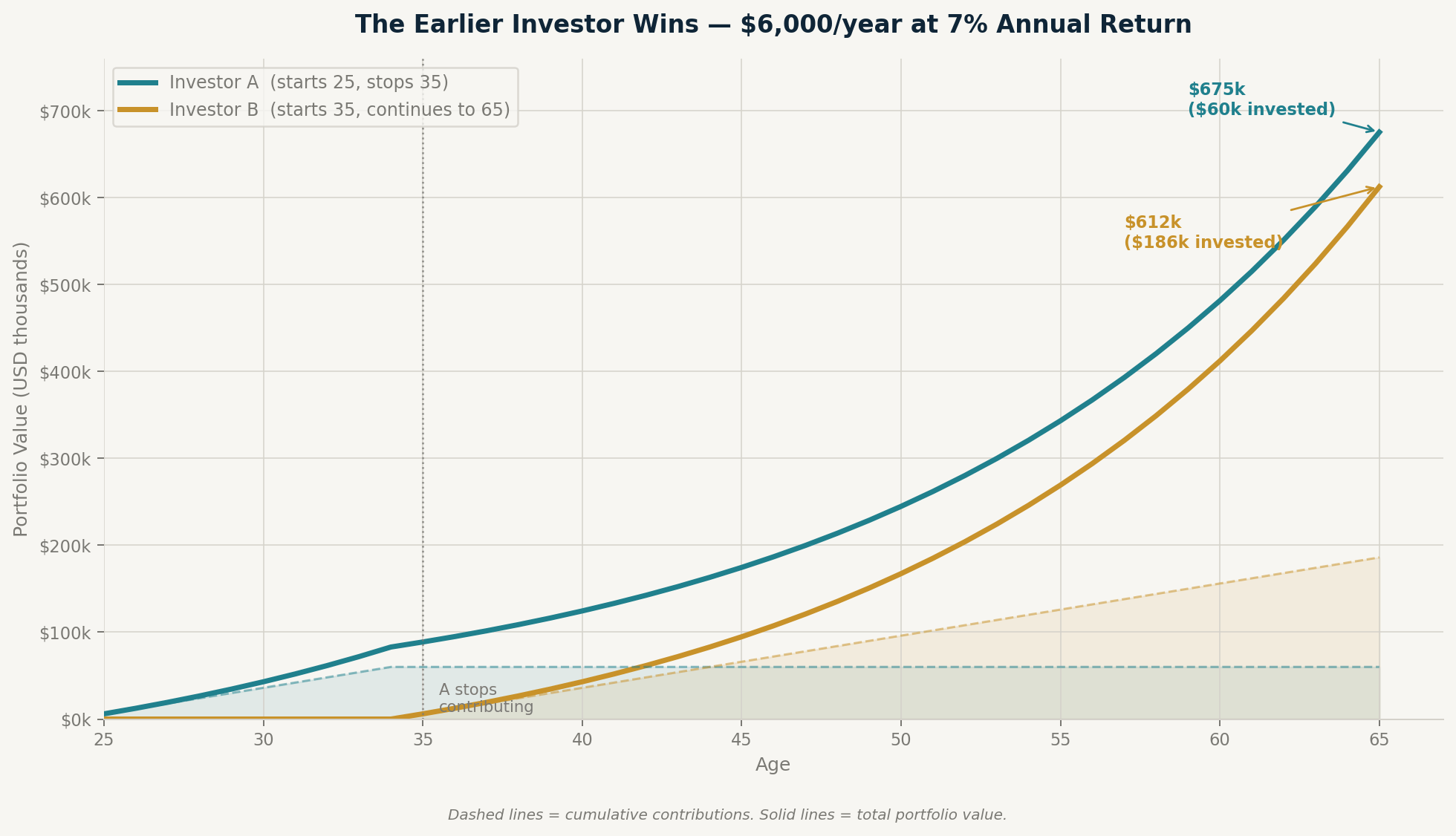
Consider two investors, both earning a 7% annual return:
- Investor A starts at age 25 and invests $6,000 per year for 10 years, a total of $60,000. At age 35, she stops contributing entirely but leaves her money invested until age 65.
- Investor B starts at age 35 and invests $6,000 per year every single year for 30 years, a total of $180,000. She also invests until age 65.
Who ends up with more?
Investor A, who contributed one-third as much money, finishes with approximately $675,000. Investor B, despite investing three times more cash out of pocket, finishes with approximately $606,000.
Investor A, who stopped contributing 30 years before retirement, ended up wealthier — because she gave compounding an extra decade to work. She put in $60,000 and gained over $615,000 on top of it. Investor B put in $180,000 and gained roughly $426,000. The difference is not discipline or skill. It is time.
Why Rate of Return Matters Less Than You Think
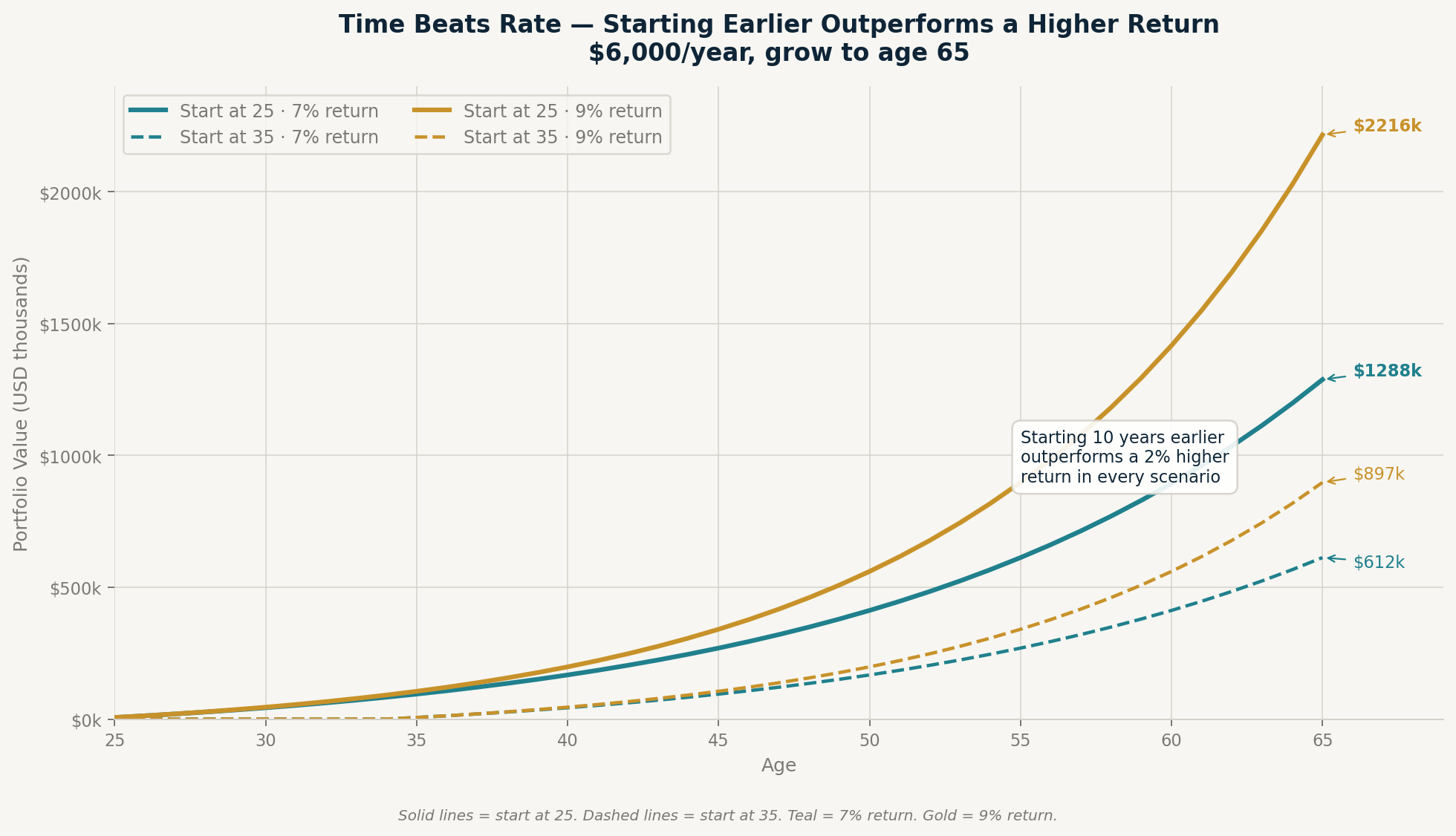
A common trap is spending years searching for a fund that returns 12% instead of 8%, believing rate of return is the decisive factor. It matters, but not as much as when you start. The Rule of 72 makes this intuitive: divide 72 by your annual return to estimate how many years your money takes to double. At 7%, it doubles roughly every 10 years. Starting 10 years earlier gives you one extra doubling: your money is twice what it would have been, regardless of contributions.
Consider the cost of delay in doubling terms:
- Start at 25 and by 65, your money has roughly 4 doublings (approximately 16x your contributions).
- Start at 35 and by 65, you get 3 doublings (approximately 8x).
- Start at 45 and you get 2 doublings (approximately 4x).
Each decade of delay does not cost you a little. It cuts your outcome in half. No rate of return can compensate for that.
The Enemy of Compounding: Interruption
Compounding is resilient over long periods, but fragile in one specific way: it requires continuity. Every time you withdraw early, panic-sell during a downturn, or stop investing for years, you reset the clock on a process that needs decades to reach full potential.
Markets will fall. The investor who stays invested through a 30% decline keeps the compounding chain intact. The one who exits, waits for “stability,” and re-enters later has broken it: sold low, missed the rebound, restarted from a diminished base. This is not an argument for ignoring risk. It is a recognition that interruption almost always costs more than a temporary decline. Markets have historically recovered from every crash. Time lost to hesitation does not come back.
Starting Is the Only Decision That Matters Today
The most expensive mistake in investing is not picking the wrong fund. It is waiting. The internal monologue sounds familiar:
- “I will start when I have more money.”
- “I will start when markets calm down.”
- “I will start when I understand it better.”
Each sounds reasonable. None of them are. Every year of delay has a calculable cost: one less doubling, one less decade of returns generating returns. The amount you invest matters less than the date you begin, as Investor A and B demonstrate.
You do not need a perfect plan or a large sum. You need a start date, and the best one available is today.
Final Thoughts
There is no secret to compounding. No algorithm, no special access, no insider knowledge. It is the simple arithmetic of returns building on returns, repeated over time. It asks only one thing: time. And time is the one resource that cannot be bought back once spent.
The question is not whether compounding works; it is a mathematical certainty. The question is how much of it you intend to use.
Key Takeaways
- Compounding is returns generating returns. It is not magic; it is math, and it works for everyone.
- The most powerful variable in building wealth is not which fund you choose. It is when you start.
- A 10-year head start can outweigh decades of additional contributions: Investor A invested one-third the cash and ended up with more.
- The Rule of 72 quantifies the cost of delay: at 7%, every decade you wait cuts your outcome roughly in half.
- Interruption by withdrawing, panic-selling, or pausing contributions is compounding’s greatest threat.
You do not need a perfect strategy. You need a start date. What is yours?